

As parents, we’re constantly balancing discipline and compassion. When a child misbehaves, our natural reaction may be to punish but is that really the best way to teach? Experts suggest there’s a better approach: understanding the difference between consequences and punishment can transform your parenting style and improve your child’s long-term behaviour and emotional development.
What’s the Difference Between Consequences and Punishment?
| Consequences | Punishment |
|---|---|
| Teach accountability | Inflict discomfort or loss |
| Focus on behaviour correction | Focus on retribution |
| Encourage learning and reflection | Can trigger fear or shame |
| Natural or logical outcomes | Arbitrary or emotional reactions |
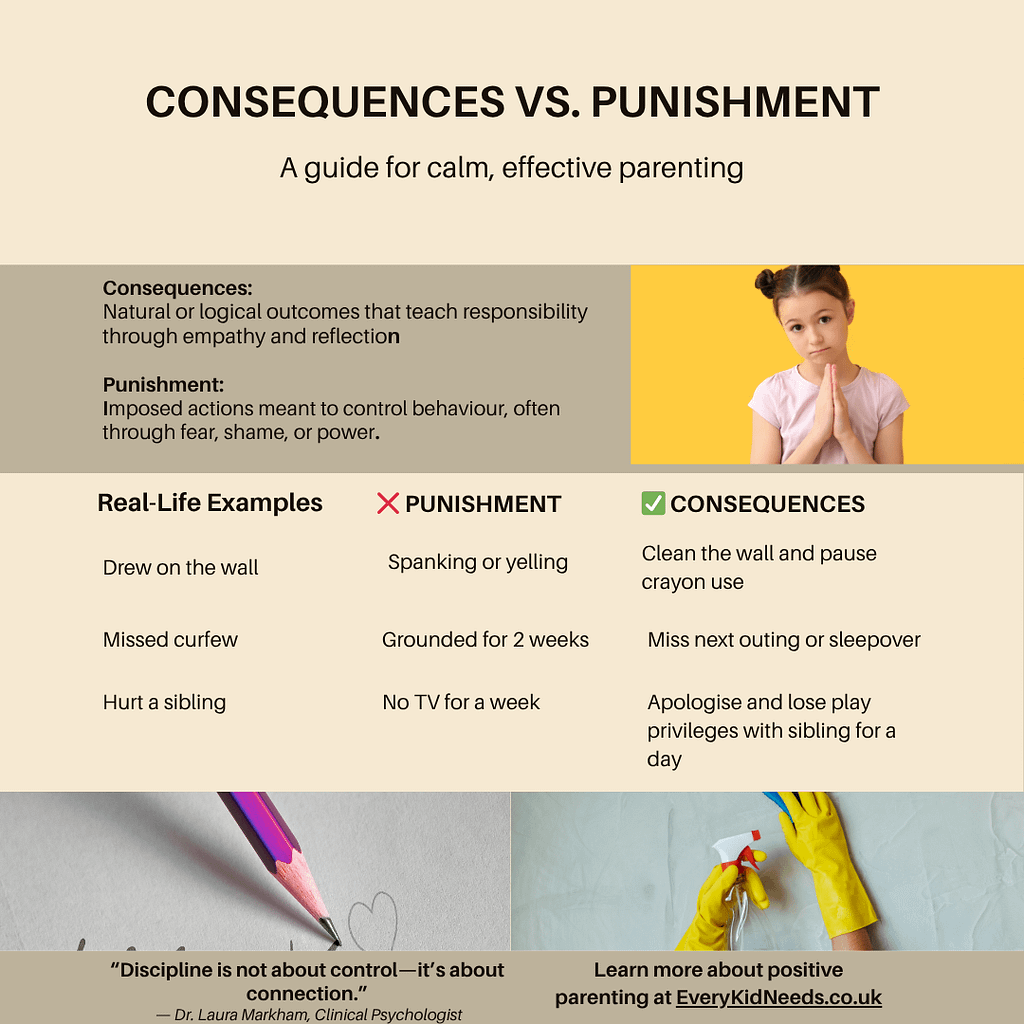
Consequences are related, respectful, and reasonable responses to a child’s actions. They help children connect their behaviour with real-world outcomes.
Punishment, on the other hand, often comes from a place of frustration or power. It may stop a behaviour in the short term but rarely teaches the right lesson.
Why This Difference Matters
1. Emotional Development and Mental Health
According to the American Academy of Pediatrics (AAP), harsh punishment, including yelling and physical discipline, increases aggression in children and leads to mental health issues like anxiety and depression (AAP Policy, 2018).
In contrast, positive discipline and natural consequences promote empathy, responsibility, and emotional regulation.
“Children internalise lessons better when they’re taught in calm, logical ways—not when they’re scared or humiliated.” – Dr. Laura Markham, Clinical Psychologist and author of Peaceful Parent, Happy Kids
2. Long-Term Behaviour Change
Punishment teaches avoidance, not values. Kids may comply out of fear but they don’t learn the why behind the behaviour. Consequences encourage children to think critically, learn from mistakes, and make better choices next time.

Examples of Consequences vs. Punishment
| Behaviour | Punishment | Consequence |
|---|---|---|
| Drawing on the wall | Spanking or yelling | Help clean the wall and no crayons until supervised |
| Ignoring curfew | Grounded for a month | Lose weekend outing privileges for 1 night |
| Breaking a toy in anger | No screen time for a week | No access to new toys until old ones are repaired or apologised for |
Types of Healthy Consequences
Natural Consequences
These happen on their own without intervention.
- If your child refuses to wear a coat, they’ll feel cold.
- If they forget homework, they’ll deal with the teacher’s response.
Important: Only allow natural consequences that are safe and age-appropriate.
Logical Consequences
Imposed by the parent, but directly related to the behaviour.
- If your child spills milk while being silly, they clean it up.
- If they hurt a sibling, they lose time playing together.
Read more about “10 Positive Discipline Strategies That Actually Work” on our Parenting Tips page.
Actionable Tips for Parents
- Stay Calm – Reacting with anger shifts focus from learning to fear.
- Be Consistent – Consequences lose power if you don’t follow through.
- Explain the Why – Always help your child connect the behaviour to the outcome.
- Let Them Try Again – Use mistakes as learning opportunities, not failures.
- Praise Improvement – Reinforce good behaviour more often than punishing bad ones.
When Does Punishment Backfire?
Research by Gershoff & Grogan-Kaylor (2016) found that spanking was associated with 13 out of 17 negative child outcomes, including more aggression, lower moral internalization, and antisocial behaviour (Gershoff Study).
Instead of fostering respect, punishment often leads to:
- Sneaky behaviour
- Fear of authourity
- Low self-esteem
- Parent-child relationship strain
The Biblical View on Discipline
For Christian parents, Proverbs 22:6 reminds us to “Train up a child in the way he should go…” Training, not punishment, is the biblical model focused on guidance, love, and correction rather than retribution.
“Fathers, do not provoke your children to anger, but bring them up in the discipline and instruction of the Lord.” – Ephesians 6:4
The Islamic View on Discipline
In Islam, discipline is deeply rooted in values of compassion, responsibility, and moral development. The Prophet Muhammad (peace be upon him) emphasised kindness in all interactions, especially with children. He said, “He is not one of us who does not show mercy to our young” (Sunan Abu Dawood, 4943).
Parents are encouraged to guide children with patience, positive example (adab), and consistent reminders rather than harsh punishment. The goal is to nurture a child’s understanding of right and wrong through love, respect, and connection to God’s teachings.
Discipline in Islam is not about control, it’s about shaping character and helping children grow into balanced, righteous individuals.
To Wrap Up
Parenting is hard but shifting from punishment to meaningful consequences makes it more effective and compassionate. By guiding your child through logic and love, you build not just obedience, but character. And that’s the kind of legacy that lasts

Want More Gentle Parenting Strategies?
- 10 Positive Discipline Strategies That Actually Work
- How to Build Resilience in Children Through Family Traditions
- Mindfulness for Children: Simple Techniques to Boost Emotional Health
Feature Image by peoplecreations on Freepik