If you’ve ever watched a four-year-old “open a restaurant” with play dough or announce they’re going to be a palaeontologist, you’ve seen early career exploration in action. It’s not about pushing kids into jobs. It’s about helping them see possibilities, learn how the world works, and build the skills that make any path easier later.
Think of it like widening their map. The more they see early on, the less scary it feels to choose a route when it really matters.
What “career exploration” actually means (for kids)
This isn’t test prep or picking a major at age eight. It’s three simple things:
- Exposure: meeting many kinds of people and roles (nurse, builder, coder, baker, park ranger).
- Language: learning the words for tools, tasks, and workplaces.
- Reflection: noticing “what I like, where I feel good, and what I’m curious about.”
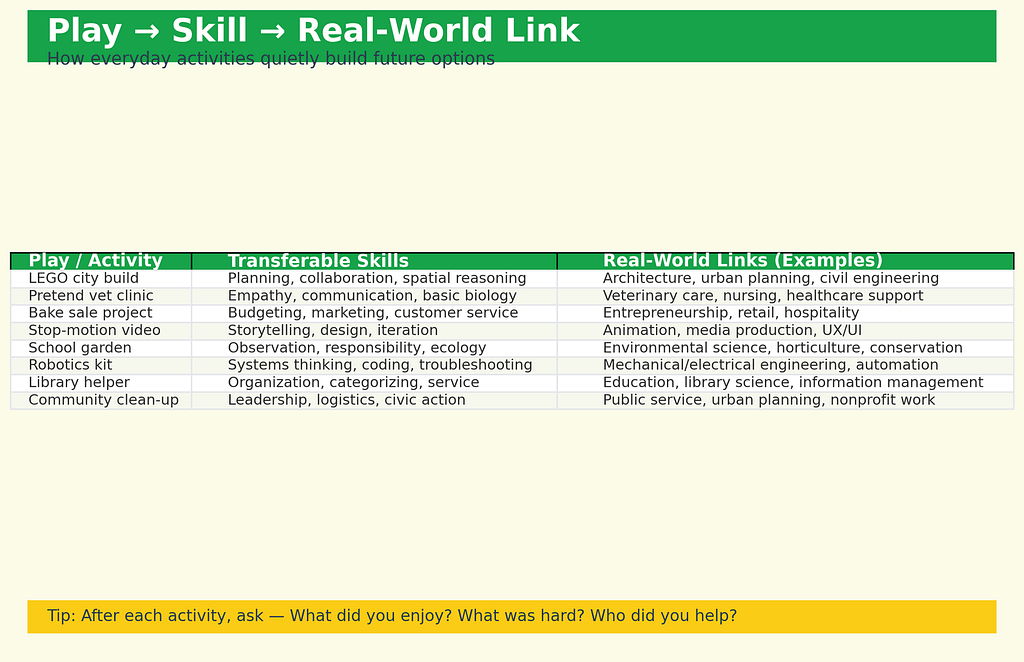
When kids try on roles through play, stories, and small responsibilities, they’re practicing real-life skills: planning, communication, problem-solving, and grit.
Why start early? (The quiet advantages)
- Confidence: Kids who regularly try new roles are less afraid of “not knowing.” That confidence shows up later in interviews, projects, and public speaking.
- Curiosity that lasts: Tiny sparks (“Why does a crane move like that?”) grow into hobbies, mentors, and sometimes careers.
- More informed choices: By secondary school, your child will have a feel for what energises them—people, ideas, hands-on work, outdoors, numbers, design.
- Equity: Early exposure helps all kids, not just those with professional networks, imagine futures they haven’t seen at home.
Ages & stages: what it looks like in real life
Preschool (3–5): play is the lab
- Set up pretend stations: vet clinic (stuffed animals + plasters), café (notepad + cups), construction (blocks + tape measure).
- Use real words: “You’re the pharmacist who checks dosage,” not just “shop helper.”
- Tiny responsibilities: “You’re today’s line leader, how will you keep us safe?”
Small story: My friend’s four-year-old spent a week “delivering post” to family bedrooms with envelopes she made. Now she notices postal workers and asks about routes, sorting, and vans. That’s the seed.
Early Primary (6–8): connect jobs to community
- Neighbourhood bingo: spot roles like bus driver, librarian, gardener, mechanic.
- Tools show-and-tell: safe, hands-on peeks, for example, measuring spoons, stethoscope toy, magnifier, old keyboard.
- Books that widen the world: picture bios of inventors, activists, athletes, chefs. This helps to show many ways to be useful.
Upper Primary (9–11): projects with purpose
- Mini-enterprises: design a bookmark, price it, write a pitch, donate profits to the library.
- Job shadow “lite”: 30-minute visits — watch a baker decorate, ask three questions, draw what you saw.
- Role rotation at home: project manager (plans dinner night), accountant (tracks grocery budget with you), engineer (fix-it helper).
Early Secondary (12–14): try, reflect, iterate
- Skills passport: a simple doc listing things they’ve done — stage crew, coding club, babysitting, Canva designs, bike repairs.
- Informational interviews: 15 minutes with a neighbour/relative about their path, what they studied, what surprised them.
- Problem-solving challenges: “Design a better backpack hook,” “Reduce plastic at school,” “Create a 2-minute video guide for new pupils.”
Later Secondary (15–18): real-world reps
- Micro-internships or volunteering: one morning at a charity shop, one festival steward shift, one Saturday at a repair café.
- Portfolio over perfection: collect proof like photos of projects, links, references, a short “what I learned” note for each.
- Decision practice: compare two paths (apprenticeship vs. sixth form), list pros/cons, cost, timeline, and a trial step (course taster, job trial).
Tools that help (light, not salesy)
- Child-friendly project ideas (maker focus): DK Maker Lab
- First STEM kit (hands-on, reusable): Snap Circuits Jr.
- Kid-safe toolbox (real tools, smaller grip): Stanley Jr. Tool Set
The three questions that steer everything
You don’t need a program. Just ask these regularly:
- What did you enjoy? (energy)
- What felt hard but worth it? (grit)
- Who did you help? (purpose)
Kids learn to choose activities that feed all three. That habit beats any “perfect plan.”
Simple weekly habits that build career skills (without extra screen time)
- One “how it works” chat: for example, bins collection, Wi-Fi, train timetables chats can unpack the systems behind everyday life.
- One maker hour: fix a hinge, bake bread, code a tiny game, plant herbs, finish something visible.
- One real audience: share a drawing with a local café, read to younger kids, submit a tip to the school newsletter. Work that reaches people feels meaningful.
You can also read how to plan a screen-free weekend that kids would love.

How to avoid common traps
- Trap: Narrow labels. “You’re the sporty one.”
Try: “You lead teams well — that works in sport and projects and events.” - Trap: Over-scheduling. Every moment is a club.
Try: Leave space for boredom; it often turns into projects. - Trap: Only “flashy” jobs. Pilot, influencer, surgeon.
Try: Spotlight essential roles too, e.g plumbers, early years educators, lab techs, paramedics.
Quick scripts you can use this week
- After an activity:
“What did you learn about yourself today?” - Before a new thing:
“What small win would make this worth it?” - When it flops:
“Okay, that didn’t land. What would you change next time?” - Meeting a worker:
“What’s a tool you couldn’t do your job without?”
A unique insight: teach “micro-apprenticeships”
Instead of waiting for a formal placement, create one-hour apprenticeships your child can repeat with different people:
- Observe (10 min): What’s the goal? What’s tricky?
- Assist (20 min): A tiny, safe task e.g label boxes, wipe tables, sort flyers.
- Interview (5 min): Ask two questions (“What surprised you about this job?” “What matters more, is it grades or practice?”)
- Reflect (5 min): One sentence —What I liked, what I’d skip, what I’d try next.
This structure is short, respectful, and builds confidence fast.
Bottom line
Early career exploration isn’t about choosing a job sooner. It’s about building a curious, capable human who knows how to learn from people, projects, and problems. Start small. Keep it playful. Celebrate effort. And keep widening the map one tiny adventure at a time.