
If you’ve noticed more teens choosing tool belts, laptops, and on-the-job training over lecture halls, you’re not imagining it. Apprenticeships are having a real moment and it’s for a good reason. I’m not anti-university. Degrees can be fantastic. But for many young people, apprenticeships offer a faster, saner, and more affordable route to a good life.
Let’s talk about why without the jargon.
A quick story
A neighbour’s son, Leo, loved pulling things apart as a kid like the remote controls, bikes, the kettle (RIP). At 17 he started a 3-year engineering apprenticeship. He earns a wage, studies one day a week, and spends the rest building things that actually get used. Last month his team installed equipment at a hospital. He came home grinning: “I can point to something and say, I helped make that work.” No debt. Real skills. A runway to a qualified role.
That feeling—useful now, not someday—is a big part of the appeal.
So… why are apprenticeships rising?
1) Learn by doing (and get paid)
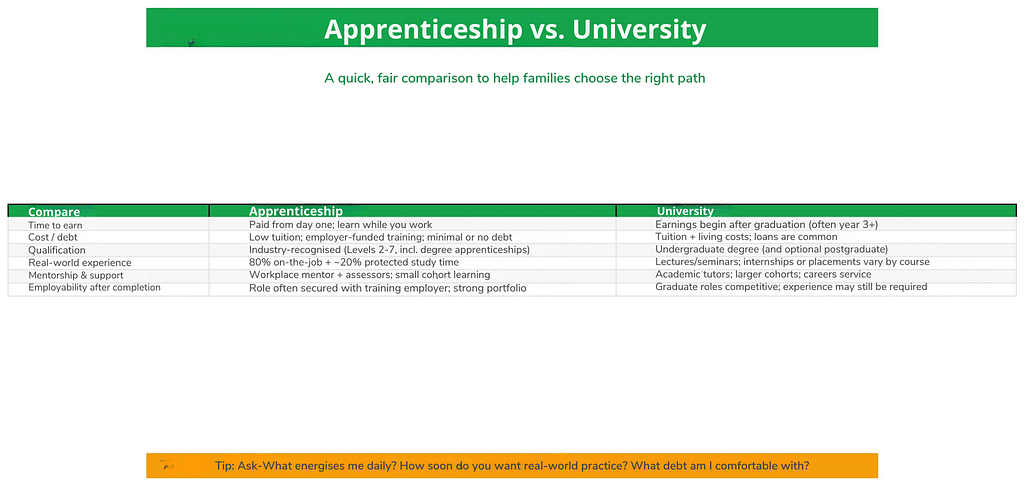
Apprenticeships flip the school model. You’re an employee who learns on the job, with training built into your week. You earn while you learn. For a lot of families, that’s huge.
2) No (or far less) debt
Instead of paying fees and living costs for years, apprentices usually have their tuition covered by the employer and receive a salary. At 21, you could be qualified, earning, and not owing anyone a penny.
3) Skills employers actually want
Because you’re learning inside a real company, you get both the technical skills and the “soft skills” (communication, teamwork, problem-solving) employers keep asking for. Your CV says, “I can do the job,” not just, “I studied the job.”
4) Clear pathways and progression
Modern apprenticeships aren’t dead-ends. Many have levels: you can start at a beginner level and climb to higher qualifications or even a degree apprenticeship without leaving employment.
5) They fit more personalities
Not everyone learns best by reading and writing essays. Some learn by testing, building, fixing, talking to customers, making a sale. Apprenticeships let those learners thrive without feeling “less academic.”
“But isn’t uni the safer bet?”
Sometimes, yes. If your dream is medicine or research, you’ll need a degree. But “safe” depends on the person and the field. In many industries like tech support, cyber security, digital marketing, engineering, health care support, construction, green energy, even finance, apprentices are snapped up because they already know the ropes.
A good question to ask is: What’s the shortest, most affordable path to the kind of work I’d actually enjoy? For a surprising number of careers, the answer is an apprenticeship.
What success looks like (with either route)
It’s not the badge; it’s the portfolio: the problems you’ve solved, the teams you’ve supported, and the value you can show. Apprenticeships push you to build that portfolio early. University can too if you mix study with projects, volunteering, and part-time work. The point is evidence, not just promise.
What kinds of apprenticeships exist now?
- Tech & Digital: software development, data analytics, IT support, cyber security, UX.
- Engineering & Manufacturing: mechanical, electrical, aerospace, mechatronics.
- Construction & Green Trades: carpentry, plumbing, roofing, heat-pump and solar installation.
- Health & Care: dental nursing, healthcare assistant, lab technician.
- Business & Creative: accounting, HR, marketing, media production, design.
- Public Services: logistics, rail, policing support roles, utilities.
There are also degree apprenticeships where you work, earn, and graduate with a university degree funded by your employer. Same cap and gown at the end but a very different journey.
Myths worth retiring
Myth 1: “Apprenticeships are only for trades.”
Not anymore. Tech, finance, and creative fields all offer them.
Myth 2: “They’re second-best.”
Tell that to the 19-year-old earning real money, with a mentor, building a portfolio, and being offered a full-time role before their peers finish first year.
Myth 3: “You’ll be stuck.”
The opposite. You’re building a network and collecting references from day one. Experience opens doors.
How to choose a solid programme (simple checklist)
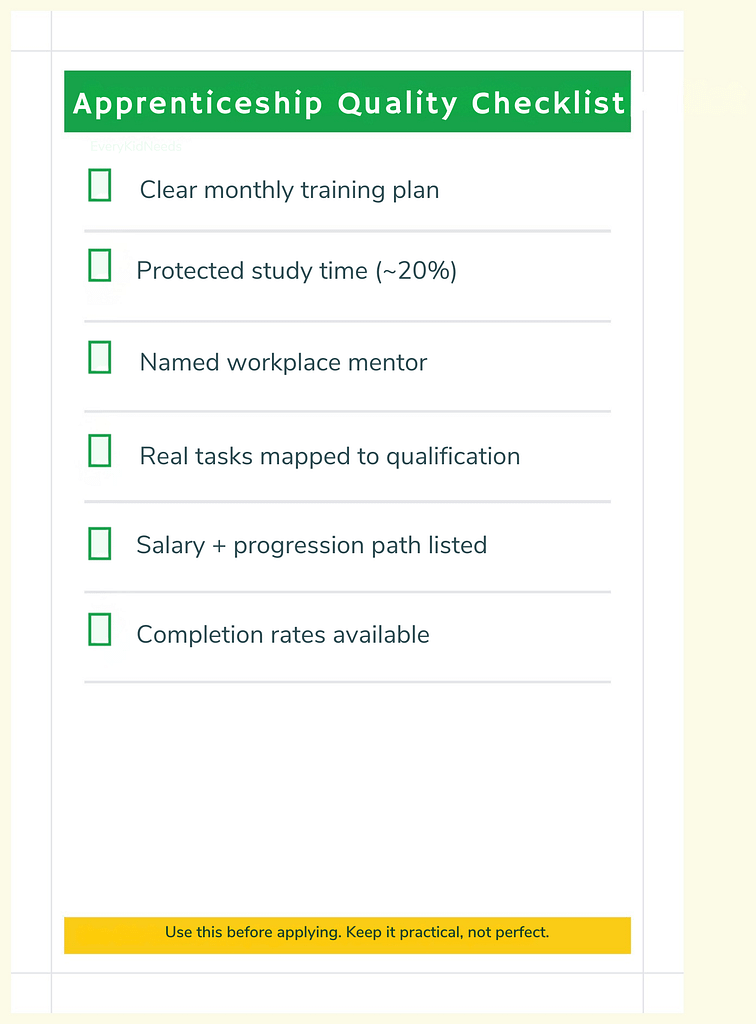
- Training plan: Does it clearly show what you’ll learn each month?
- Accreditation: Is the programme recognised in your industry?
- Mentoring: Will you have a named supervisor who actually coaches you?
- Day-release or study time: Is there protected time for learning, not just working?
- Pay + progression: What’s the wage now, and what’s typical after completion?
- Success rate: How many apprentices finish? How many get hired permanently?
If a company can’t answer these, walk away. A good programme is proud to share details.
How to find one (without going in circles)
- Government apprenticeship portals (search “apprenticeships + your country”).
- Employer websites—many advertise schemes directly.
- Colleges and training providers—ask about employer partners.
- Career fairs / open days—face-to-face chats still matter.
For parents (because you care)
Your role isn’t to decide—it’s to open doors and lower friction.
- Help with transport for interviews.
- Read the contract together; ask the “boring” questions.
- Celebrate effort, not just offers. Every application builds muscle.
- Remember: apprenticeships aren’t “second best.” In many sectors (tech, trades, health, media), they’re the fast lane to skilled work.
Some questions to answer
Will an apprenticeship limit future options?
No. Many apprentices later move into new roles, gain higher qualifications, or even switch industries with the experience they’ve built.
Is the pay enough to live on?
It varies. Entry pay can feel tight, but increases are common as skills grow. Some employers are very competitive—especially in tech and engineering.
Can you still go to uni later?
Absolutely. Some apprentices transition into part-time or full-time degrees, often with employer support.
Bottom line
Apprenticeships are becoming the new university not because university has failed, but because work has changed. Employers prize capability. Young people want purpose, pay, and progress. Apprenticeships offer a head start on all three.
If your child loves learning by doing, likes seeing impact quickly, and prefers a clear path into paid work, this route could be a brilliant fit. Make a cup of tea, open the tabs, and explore what’s out there. The right door is the one that opens into momentum and there are more doors than ever.