Let’s tell the truth: a lot of us have been parenting with an invisible audience in mind.
Not because we’re fake parents. Not because we don’t love our kids. But because somewhere along the way, parenting became something we show, not just something we live.
You know that moment when kids are finally doing something cute or cooperative and your first thought is, “Let me record this.” Not, “Let me be in this.” That’s the switch I want to talk about.
This is the year we can stop performing parenting online and return to present parenting at home.
How we got here
Social media didn’t start as a parenting competition. But slowly, “here’s a fun activity for toddlers” became “look how tidy, calm, minimalist, Montessori, and gratitude-based our lives are.” And if your house had cereal on the floor and a child wearing one sock and a crown, you started to feel like you were doing it wrong.
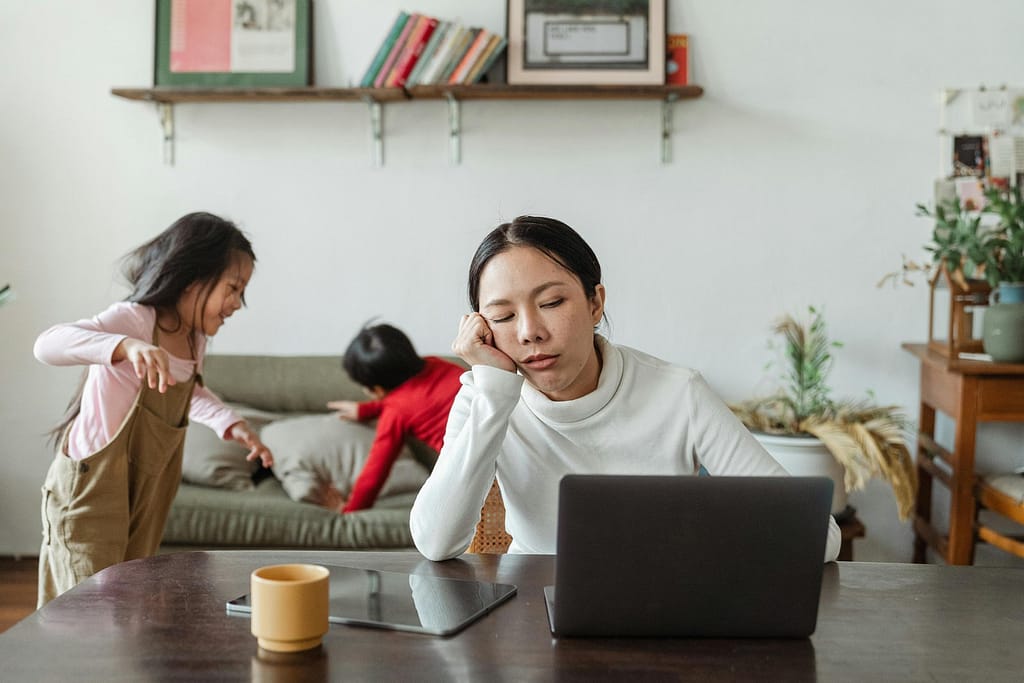
The problem? Real parenting is loud, repetitive, and not very aesthetic. Screenshots don’t capture:
- the third tantrum before 9am,
- the child who “suddenly” doesn’t like the food they loved yesterday,
- the parent who is deeply tired but still shows up.
So the online version of parenting starts to feel cleaner than the real thing. And that creates shame.
Performative vs. Realistic Parenting
Performative parenting asks:
- “How does this look?”
- “Will this get likes?”
- “Will other parents think I’m doing it right?”
Realistic parenting asks:
- “Does this work for our family?”
- “Is this kind to my child and to me?”
- “Can I keep doing this on a Wednesday when I’m exhausted?”
Realistic parenting is not lazy. It’s sustainable. It’s the version your kids actually remember.

The harm of parenting for the internet
- It shifts the goal. Instead of raising confident, emotionally healthy kids, we start chasing tidy moments.
- It makes us impatient. Real progress with kids is slow; Instagram progress is 30 seconds.
- It creates invisible pressure. You start talking to your kids like you have an audience—over-explaining, over-therapizing, over-“mindful-ing”—instead of talking like a mum/dad who knows this child.
- It erases your context. You may be parenting in the UK, on shift work, with multiple kids, with health challenges, of course it won’t look like a stay-at-home mom in California with a nanny and natural light.
So if you’ve ever felt, “I can’t keep parenting like this,” you’re not the problem. The performance is.
Signs you might be performing
- You do an activity mainly because it will “look good.”
- You feel guilty when your home/child/day doesn’t look “content-worthy.”
- You feel low after scrolling parenting reels, even when they’re “inspirational.”
- You second-guess good decisions because they don’t match what’s trending.
- You’re rarely in photos because you’re always making the content.
If any of that stung a little, it’s okay. That just means you’re self-aware. That’s a good thing.
So what does realistic parenting look like?
Let’s make it plain.
- Simple, repeatable routines
Breakfast, school run, homework, screens, bedtime which are done mostly the same way. Not every day is a themed craft day. Predictability beats perfection. - Good enough home environment
Not spotless and not chaotic but functional. Kids can find their shoes. You can find your keys. Laundry may be folded… later. - Activities that serve your child, not your feed
Maybe your child actually prefers messy play, or Roblox, or football at the park. That’s fine. Realistic parenting follows your kid, not Pinterest kids. - Honest emotion
“I love you, and I’m also tired.” Kids need to see humanity, not filters. - Rest for the parent
A parent who never rests will eventually start resenting parenting. Realistic parenting protects the parent.
A gentle social media reset (you can do this today)
- Unfollow 5 accounts that make you feel “not enough.”
- Follow 3 real/ordinary parents who show messy days or neurodiverse realities or working-parent days.
- Stop posting kids’ hard moments. Their feelings aren’t content.
- Post later, not live. Be present first, share after and that’s if it still feels worth sharing.
- Add a note in your phone: “My child doesn’t need an audience. They need me.”
What to teach our kids about this
Because they’re watching us.
- “We don’t have to share everything.”
- “Special doesn’t mean public.”
- “We choose what belongs to our family.”
- “Real life > online life.”
If we model non-performative parenting, we raise kids who don’t perform their whole childhood for likes.
When you DO want to post
Posting isn’t bad. Community isn’t bad. Some of us build businesses, ministries, or support networks online. The goal isn’t to disappear but to post from truth, not from pressure.
Ask before sharing:
- Does this protect my child’s dignity?
- Am I sharing to help someone or to prove something?
- Would I be okay if my child saw this at 14?
If yes, post with peace.
Final encouragement
You’re allowed to parent quietly.
You’re allowed to enjoy your child without capturing it.
You’re allowed to have an un-aesthetic Tuesday and still be an excellent parent.
Let this be the year we stop performing parenting online and start actually living it with grace, with limits, and with the kind of presence our kids will remember long after the internet has moved on.