

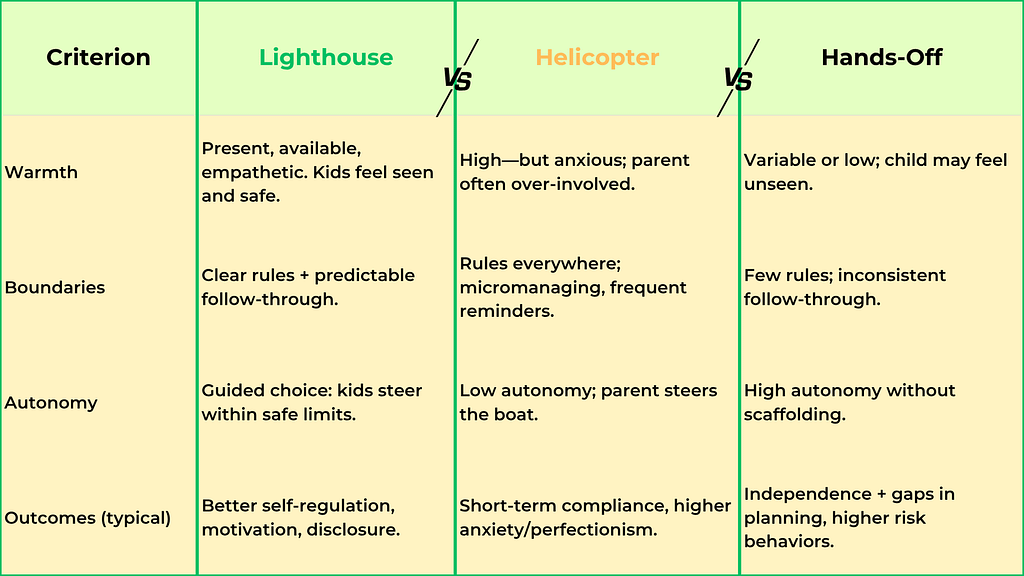
If “helicopter” sounds smothering and “hands-off” sounds scary, lighthouse parenting might be your sweet spot. You are present and steady—visible from shore—but you are not in the boat grabbing the wheel. You set the boundaries, signal danger, and let your child learn to navigate.
Below is a grounded, research-backed guide with practical examples you can use tonight.
What is lighthouse parenting?
Think of three parts:
- Be visible and available. Your child knows where you are and how to reach you.
- Set the shoreline. Clear rules, predictable routines, and agreed-upon consequences.
- Let them steer. Age-appropriate freedom to choose, try, and recover from small mistakes.
This approach aligns with authoritative parenting (warmth + structure), which consistently predicts better academic, social, and mental-health outcomes than either permissive (too loose) or authoritarian (too tight) styles. It also fits autonomy-supportive parenting from Self-Determination Theory (Deci & Ryan): kids do best when they feel competent, connected, and in control of meaningful choices.
Why it matters: Teens who feel trusted and monitored without being controlled tend to disclose more, take fewer risky shortcuts, and develop stronger self-control.
A simple framework you can remember
1) Shoreline rules
Choose 3–5 non-negotiables (safety, sleep, respect, tech limits). Post them where everyone can see.
Script: “These are the house rules. They keep everyone safe and sane. We’ll flex on the rest.”
2) Signal the weather
Preview challenges instead of lecturing after the fact.
Script: “The group chat might heat up tonight. If it does, take a break and text me ‘🚩’ so I know you need a reset.”
3) Let them steer
Offer bounded choices: real options within your limits.
“Homework before or after dinner?”
“Bike or bus to school on dry days?”
4) Natural & logical consequences
If they miss curfew, a short-term privilege tied to that freedom pauses. No drama, no lecture. Debrief later.
5) Debrief the voyage
Reflect after calm returns.
Script: “What went well? What snagged you? What’s your plan for next time?”
What the research suggests (in plain English)
- Warmth + boundaries work. Decades of studies on authoritative parenting show better grades, fewer behavior problems, and stronger well-being than harsh or permissive approaches.
- Monitoring beats micromanaging. Teens who choose to share information (because parents are warm and fair) have lower risk behaviours than those heavily surveilled.
- Autonomy builds motivation. When kids experience meaningful choices and clear rationale for rules, they internalise values instead of obeying only under watch.
Translation: Be kind, be clear, and give room.
Age-by-age examples
Ages 6–9
- Shoreline: “Screens are off at 7:30.”
- Steering: Kid chooses which 30-minute show and sets the timer themselves.
- Debrief: “How did your timer help you stop on time?”
Ages 10–13
- Shoreline: “Phones charge in the kitchen at 9.”
- Steering: They pick a wind-down routine (journal, playlist, book).
- Debrief: “Which routine helps you fall asleep fastest?”
Ages 14–17
- Shoreline: “Curfew 10:30 on school nights.”
- Steering: Teen drafts the plan: where, who, transport, check-in time.
- Debrief: “What would you change about tonight’s plan?”
Red flags (so you can course-correct)
- Hovering: You solve problems before your child tries. You remind more than they act.
- Hands-off: You don’t know passwords, friends, or whereabouts. There’s no consistent follow-through.
- Lighthouse: You set expectations, preview risks, and step back, then step in only when safety or integrity is at stake.
Routines that make lighthouse parenting easy
- Family check-in (15 minutes, once a week). Ask: “What’s one win? One worry? One plan?”
- Shared calendar. Teens add their own times and rides. (Natural responsibility builder.)
- Two-step tech rule. 1) Ask “What’s the goal?” before opening a device. 2) Set a stop-time before starting.
Conversation scripts for common flashpoints
Homework
“Your job is to choose a 45-minute focus block before 8. My job is to ask what support you want. Where do you want to work tonight?”
Group chats
“If the chat turns mean, screenshot and step out. I’ll help you decide whether to report or ignore. Your values are greater than the dopamine hit.”
Curfew
“If you’re late, you’re telling me the plan wasn’t solid enough. We’ll pull back next weekend and rebuild trust.”
Teach them to run micro-experiments
Lighthouse parenting isn’t only guardrails; it’s guided practice. Help your child design tiny, low-risk experiments to learn self-management:
- “Try a 25-minute homework sprint with your phone in another room. Rate your focus 1–10.”
- “Test two bedtime routines this week like music vs. reading and tell me which helps you fall asleep faster.”
- “Before a hangout, write your ‘if-then’ plan: If the plan shifts, then I text home for a quick check-in.”
Now you’re not just enforcing rules; you’re training a scientist of their own life.
Light, not salesy, tools that pair well with this approach
- A practical, science-based read on autonomy and stress:
👉 The Self-Driven Child (Stixrud & Johnson) — Amazon - Classic communication strategies for calm authority:
👉 How to Talk So Kids Will Listen & Listen So Kids Will Talk — Amazon - A simple weekly whiteboard for shared plans and chores:
👉 Magnetic family planner board — Amazon
Quick start checklist
- Write your 3–5 shoreline rules
- Add one preview (“signal the weather”) to tonight’s plan
- Offer one bounded choice your child can make
- Replace one lecture with a next-day debrief
- Try one micro-experiment this week
Bottom line
Be the steady light. Set the shore.
Teach the map. Then let them steer.
They won’t just get where they’re going, they’ll learn how to captain the boat.

Picky Eater Tips and Healthy Family Meals: Easy Ways to Make Mealtime Less Stressful
If you have a picky eater at home, you already know mealtime can feel like…
Lunch for a Picky Eater: 20 Quick, Budget-Friendly Ideas for Picky Eaters
If packing lunch for a picky eater had an Olympic event, many of us would…

5 Parenting Habits Our Kids Will Probably Call Us Out On (And What to Do Instead)
Let’s be honest: every generation of kids eventually grows up and says some version of,…

How to Move from Controlling Screens to Teaching Digital Self-Control
If you’ve ever found yourself counting screen minutes, negotiating “five more minutes,” or hiding the…

Evidence-Based vs. TikTok Parenting Advice: How to Tell What Actually Helps (and What to Skip)
Image by wayhomestudio on Freepi If you’re a parent on the internet, you’ve probably learned…

What to Do When You and Your Partner Have Different Parenting styles
Let’s be honest: parenting is hard enough when you agree on everything. When one of…