

Using AI tools like chatbots, smart assistants, learning apps can feel so helpful. But like any tool, there are trade‑offs. It’s good to know what they are so you can avoid the pitfalls.
I pulled together research and expert insight to show the less obvious downsides because smart parenting isn’t just about what helps, but what might hurt if we don’t stay alert.
1. Loss of Critical Thinking and Problem‑Solving
When kids lean on AI tools to do things for them like solve math problems, write essays, suggest answers, they may miss out on the struggle part.
- A piece in Psychology Today warns that AI shortcuts can weaken creative problem‑solving and resilience because children skip steps where real learning happens.
- Another study of large‑language‑model tools in education found that over-reliance can reduce opportunities for children to think things through themselves.
What You Can Do:
Encourage “AI + effort.” Let AI suggest, but ask your child to explain their own reasoning. Give them non‑AI versions of tasks sometimes.
2. Privacy, Data Security & Bias
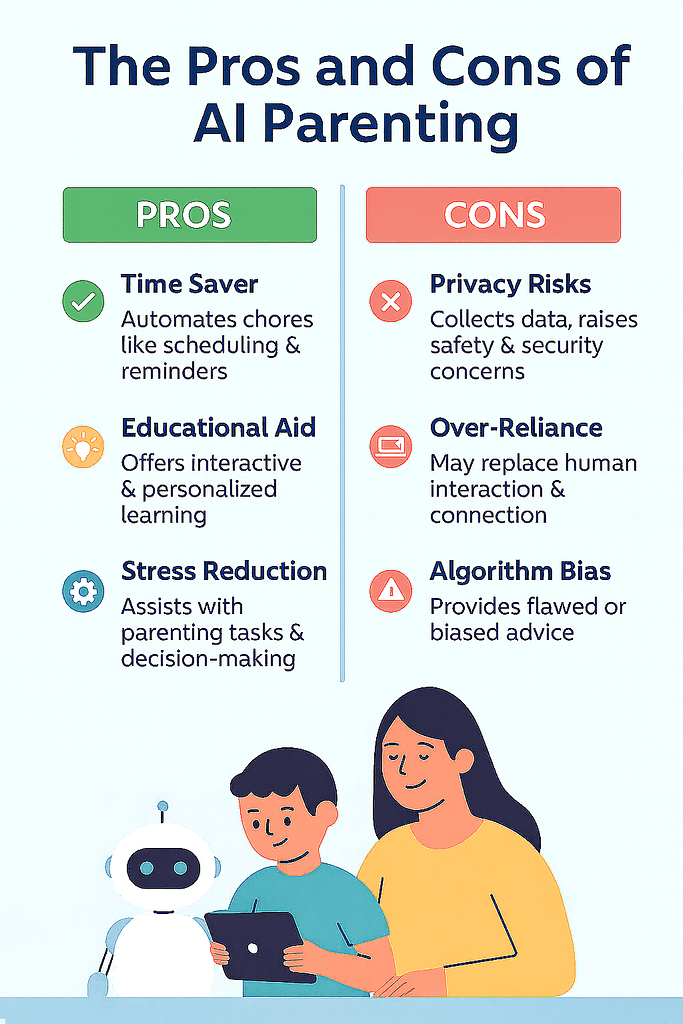
Most AI tools collect a lot of data like speech, behaviour, preferences, sometimes location. That raises risks:
- There pushback from parents and researchers over what happens with kids’ data. Who owns it? Who has access? Could it be sold or hacked?
- Bias: If AI is trained using biased or non‑representative information, it can subtly reinforce stereotypes (gender, race, culture).
What You Can Do:
- Check privacy policies before using tools.
- Use tools from reputable companies with transparent data practices.
- Teach kids “this is a tool, not a perfectly neutral judge.”
3. Over‑Dependence & Reduced Human Connection
If AI starts doing too much for us like reminding, advising, calming, kids might begin relying on a digital assistant more than they lean on parents or peers.
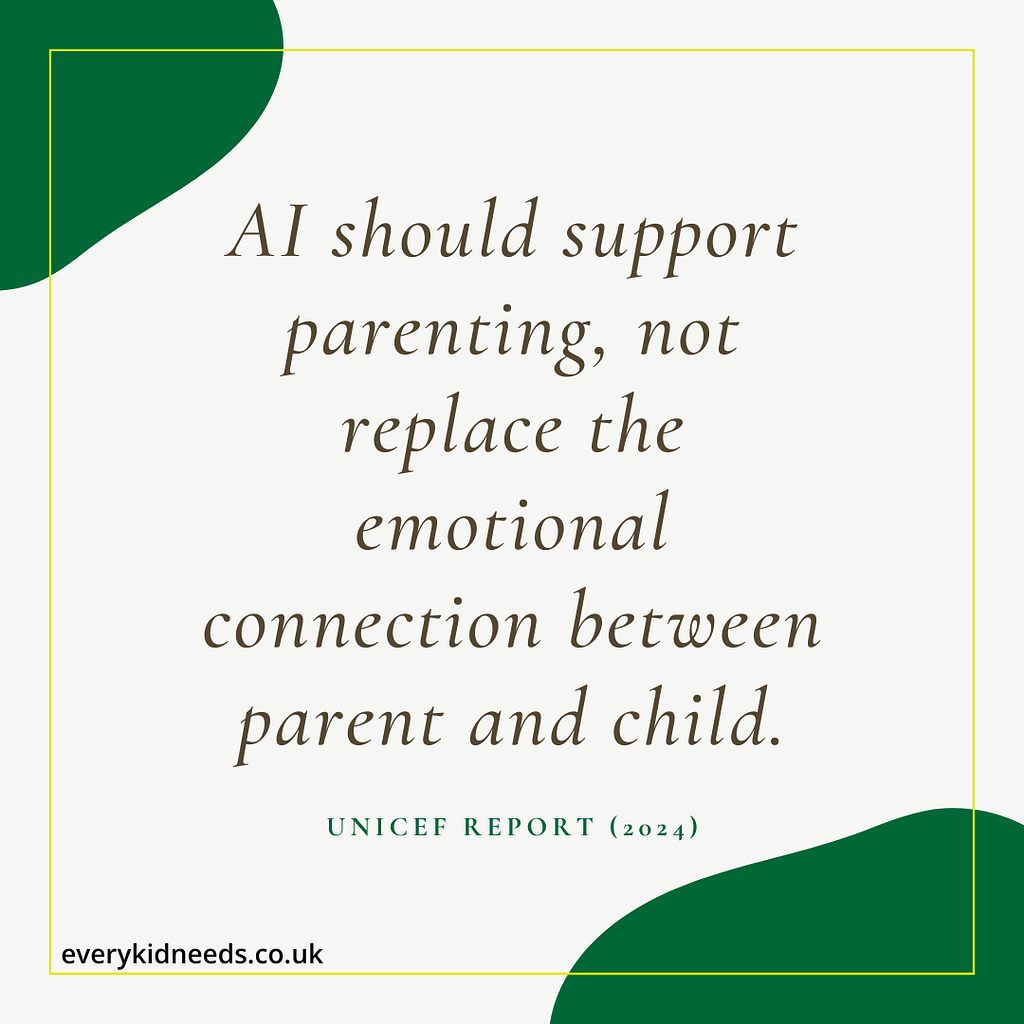
- UNICEF in a recent report points out risks of algorithms reducing social skills because children sometimes interact more with AI than humans.
- Parents’ perspectives research also mentions that AI may interfere with important parent‑child interactions when children expect AI to solve things.
What You Can Do:
Use AI as a supplement and not as a replacement. Make sure you carve out time where AI is off-limits and human interaction rules (e.g., family dinner, bedtime chat).
4. Unequal Access & Socioeconomic Disparity
Not all families have equal access to high-speed internet, smart devices, or cost‑affordable AI tools. This can widen gaps.
- Reports from EducationWorld and UNICEF show many parents worry AI in education will magnify inequality, because children from wealthier backgrounds will have more and better AI tools.
What You Can Do:
Try free or low‑cost AI tools, or ones that work offline. Be aware of what your child needs versus what’s “nice to have.” Advocate for equitable access if you can.
5. Lack of Regulation & Transparency
AI is evolving fast. But law, ethics, and oversight are often lagging behind.
- The Nature review on ethical implications in child health AI notes that many systems are not transparent, they don’t explain how they make decisions. That’s risky, especially when being used with children.
- Studies show that guidelines and ethical frameworks often mention kids, but actual enforcement or clear standards are rarely in place.
What You Can Do:
Choose tools that explain their logic. Ask questions like, “Why did this AI suggest that?” or “What data does this tool use?” Push for stronger regulations and ethical design.
6. Unpredictable Content & Misinformation
AI doesn’t always get it right. Sometimes suggestions are inaccurate, misleading, or biased.
- Some apps or chatbots may give general advice that’s fine for many but wrong for your child’s situation.
- A study of parents using ChatGPT for health advice found that parents often trusted AI more than they should, even when the advice was generic or medically ambiguous.
What You Can Do:
Always cross‑check critical info (health, safety, learning) with trustworthy sources: pediatricians, education experts, teachers. Use AI suggestions as brainstorming, not gospel.
How to Use AI Wisely
AI can be a strong helper in parenting if used carefully. The downsides don’t mean you shouldn’t use it, but they do mean you need boundaries:
- Be intentional: Decide when and where you’ll use AI in your home.
- Educate your child: Teach them both the power and limits of AI.
- Stay hands-on: Your involvement matters, don’t allow tools to replace love, judgment, or your unique knowledge of your child.
When used mindfully, AI can lighten your load without dimming the human parts that matter most: your connection, your influence, and your child’s sense of agency.