
Let’s be honest: parenting is hard enough when you agree on everything. When one of you is more “rules and routines” and the other is more “go with the flow,” it can feel like you’re playing for two different teams. You’re not. You both care about the same kid, you just come at it differently.
This is a simple, calm plan for finding common ground (and a little peace at home).
Start with what’s actually different (not who’s “right”)
Skip the labels and talk about behaviours you can see:
- Limits: When do we say “no,” and how often?
- Follow-through: What happens if a rule is broken?
- Tone: How do we talk when we’re stressed?
- Autonomy: How much choice do kids get at different ages?
- Hot spots: Screens, sleep, school, where do we clash most?
Jot bullet points. Seeing the gaps on paper makes them way less personal.
You don’t need the same style. You need the same plan.
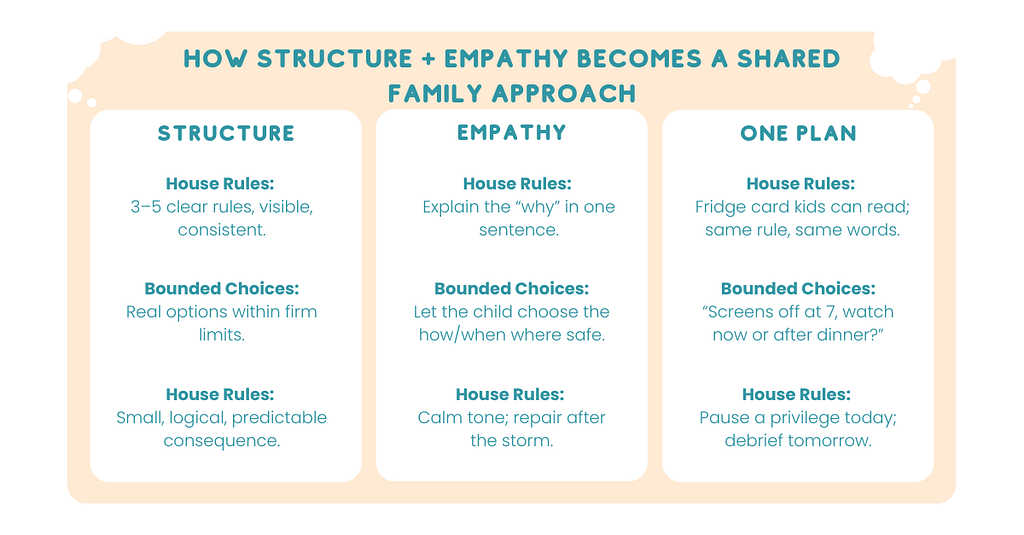
Align the basics: values → principles → 3–5 house rules
Think of it like building a little family playbook.
Values: safety, respect, effort, honesty, rest.
Principles: calm tone, predictable routines, small logical consequences, real choices.
House rules (short enough for kids to remember):
- We speak respectfully.
- Screens end at 7.
- Homework block before 8.
- We fix what we break.
Print it. Stick it on the fridge. Let the system do some of the talking so it’s not “Mum vs. Dad.”
“One leads, one supports” (and switch later)
In your repeat battlegrounds (bedtime, homework, getting out the door), choose who leads in the moment and who backs them up.
- Lead parent handles the script.
- Support parent stays quiet and backs the call.
- If you disagree, press pause and talk privately, then come back united.
This shuts down “but Dad said…” triangles fast.
Quick line to use:
“I’m with Mum/Dad. We’ll talk later and let you know if anything changes.”
A tiny tool for tricky decisions: CLIP
When you’re stuck, run it through CLIP:
- Consequence: What naturally happens if we do nothing?
- Level: Core value (non-negotiable) or just preference (flex)?
- Impact: Which option teaches the best long-term skill?
- Practical: Can we keep this up on a tired Wednesday?
If it fails “Practical,” adjust the plan. A rule you can’t stick to just breeds arguments.
Weekly 20-minute “Parent Huddle” (no lectures, just wins + tweaks)
When: same night each week, after bedtime.
How:
- Wins (2 min): one thing each kid did well.
- Hot spot (5 min): pick one issue (not five).
- Plan (8 min): house rule + choice + consequence.
- Who leads next time (2 min).
- Thank-you (3 min): appreciate one thing your partner did.
Keep notes in a shared doc so you’re not reinventing the wheel every week.
Bounded choices = both of your styles, together
Give kids real options inside your limits:
- “Screens off at 7. Watch now or after dinner?”
- “Homework block before 8. Desk or kitchen table?”
- “Home by 9:30. Text at 9:00 or share location?”
Empathy gets a voice, structure keeps its backbone.
Common friction points—here’s the middle ground
Screens
- Rule: “Screens end at 7.”
- Choice: “30 minutes now or after dinner.”
- Consequence: “If stopping is hard today, tomorrow’s slot is shorter.”
- Who leads: Parent A sets timers; Parent B handles transitions.
Bedtime
- Routine card: wash → PJs → story → lights.
- Ticket: one “get-up” pass per night. When it’s used, it’s used.
- Consequence: door mostly closed if the pass is gone.
- Who leads: Parent B reads; Parent A does logistics.
Back-talk
- Rule: “We speak respectfully.”
- Script: “Try that again, please.”
- Consequence: “Conversation pauses; we try in 10 minutes.”
Short, steady, repeatable.
What the research quietly says
- Warmth + structure wins. The “authoritative” blend predicts better behaviour, school outcomes, and mental health than harsh or hands-off approaches.
- Fair monitoring beats control. Kids share more (and push less) when limits feel consistent and respectful.
- Consistency > intensity. Small, predictable routines and consequences beat big, rare punishments every time.
Translation: combine one parent’s connection with the other’s clarity.
What not to do (even if you’re frustrated)
- Don’t correct your partner in front of the kids, use the two-minute private huddle.
- Don’t cite “experts” as weapons but share ideas, not verdicts.
- Don’t keep score, trade leadership roles and name each other’s strengths.
Co-parenting with an ex? Same rhythm, softer edges
- Keep shared rules thin and clear (curfew, phone charging spot, meds).
- Use a neutral info doc (school dates, consequences used).
- No commentary about the other home in front of the child.
- Talk to skills, not styles: “We’re both helping you practice being on time.”
One-week alignment plan
- Today: Write 3–5 house rules and post them.
- Tue: Pick one hot spot; choose who leads.
- Wed: Add one bounded choice to that spot.
- Thu: Use one small, logical consequence quietly.
- Fri: Do your 20-minute huddle; tweak one thing.
- Sat: Do something fun as a family that isn’t “content.”
- Sun: Thank your partner out loud for one specific parenting win.
Small steps, big calm.
Bottom line
You don’t need to become the same kind of parent. You need a shared map, a few clear rules, and a habit of backing each other in public and fixing it in private. When parents stop competing and start coordinating, kids relax and the home does too.
Here is another helpful article on parenting styles – Lighthouse Parenting vs. Helicoptering: How to Find the Calm Middle