

Co-parenting is hard when both parents are trying but not agreeing
Co-parenting can feel emotionally heavy when two parents love the same child but see parenting differently. One parent may believe in firm rules, structure, and consequences. The other may prefer flexibility, patience, and giving the child more freedom. On their own, neither approach is automatically wrong. The real problem starts when the child is caught between two different systems.
When parents are not on the same page, children often become confused. They may hear one rule in one home and a different rule in the other. They may learn which parent is more likely to say yes. They may also feel pressure to take sides, even when nobody directly asks them to.
That is why families need more than good intentions. They need a simple, calm, written plan that both parents can follow, especially when emotions are high.
This is where the “One Plan” system comes in.
It does not mean both parents must think exactly alike. It means both parents agree on the basic rules, routines, and communication habits that help the child feel safe, loved, and guided.
Why different parenting styles cause tension
Different parenting styles often come from different backgrounds, values, fears, and personal experiences. One parent may have grown up in a strict home and believe children need clear boundaries. Another may have experienced harsh discipline and now wants to parent with more softness.
Sometimes the disagreement is not really about bedtime, screen time, homework, or chores. It is about deeper questions like:
“Are we being too strict?”
“Are we being too soft?”
“Is our child learning responsibility?”
“Will they feel loved and supported?”
“Are we raising them with enough discipline for the real world?”
These are valid concerns. But when parents argue in front of the child, cancel each other’s decisions, or use the child as the messenger, the child becomes the emotional middle person.
The goal is not to erase your differences. The goal is to build a shared parenting structure strong enough to hold those differences without creating daily conflict.
What is the “One Plan” system?
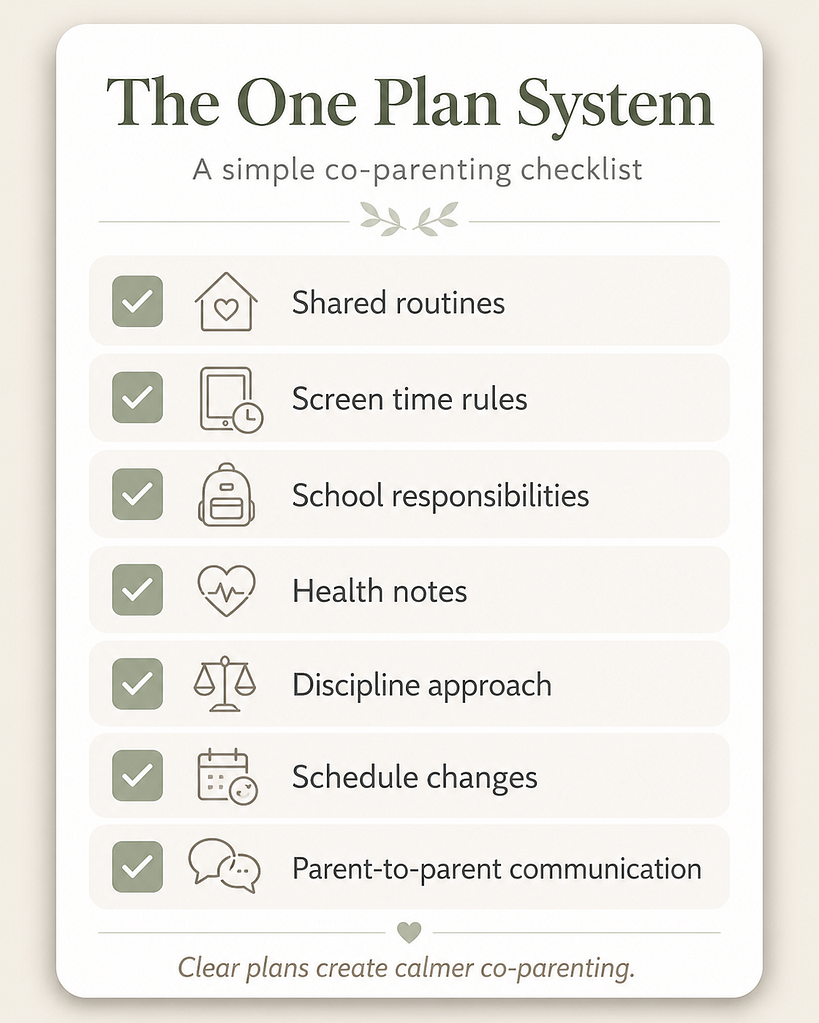
The “One Plan” system is a simple co-parenting method where both parents agree on a few non-negotiable parenting areas and document them clearly.
It helps parents move away from emotional, last-minute arguments and toward predictable decisions.
The plan usually covers:
- Daily routines
- School responsibilities
- Screen time rules
- Discipline and consequences
- Health and medication notes
- Pick-up and drop-off arrangements
- Communication expectations
- Emergency decisions
- Special events and schedule changes
The beauty of the system is that it reduces the need to debate every small issue repeatedly. Once the plan is agreed, both parents can refer back to it instead of restarting the same argument every week.
Step 1: Agree on the child’s needs before debating parenting styles
Before talking about rules, both parents should first agree on what the child needs.
This changes the tone of the conversation.
Instead of saying, “You are too strict,” or “You are too relaxed,” try asking:
“What does our child need from both of us right now?”
Most parents can agree that children need safety, love, consistency, rest, education, emotional support, healthy boundaries, and a sense of belonging.
Once you agree on the child’s needs, it becomes easier to discuss parenting decisions without making the other parent feel attacked.
For example, instead of saying:
“You always let him stay up too late.”
You could say:
“I think he needs a more consistent bedtime because he struggles the next morning. Can we agree on a school-night routine?”
That small change can reduce defensiveness and keep the focus on the child.
Step 2: Choose your non-negotiables
Not every parenting difference needs to become a battle. Some things are preferences. Others are values. A few are true non-negotiables.
A co-parenting plan works best when both parents identify the areas where consistency matters most.
Good non-negotiables may include:
School attendance and homework: Both parents agree that school responsibilities must be taken seriously.
Health and safety: Medication, allergies, doctor appointments, emergency contacts, and safety rules must be shared clearly.
Sleep routines: Bedtime may not be identical in both homes, but school-night sleep expectations should be reasonably consistent.
Respectful communication: Children should not be allowed to insult, threaten, or manipulate either parent.
Screen time limits: Both parents should agree on basic boundaries so one home does not become the “unlimited device” home.
Discipline approach: Consequences should be fair, age-appropriate, and not used as revenge or emotional punishment.
The key is to keep the list realistic. If everything becomes a non-negotiable, the plan will feel controlling. If nothing is agreed, the child may experience too much inconsistency.
Step 3: Create one shared rule for common conflict areas
Many co-parenting disagreements happen around the same few topics: devices, bedtime, food, schoolwork, chores, friends, and discipline.
Instead of arguing each time, create one shared rule for each area.
For example:
Screen time rule:
On school nights, devices are put away by 8:30 p.m. Homework and chores must be completed first.
Homework rule:
Homework should be checked before recreational screen time.
Bedtime rule:
The child should be in bed by 9:00 p.m. on school nights, unless there is a special event.
Discipline rule:
Consequences should be explained calmly and should match the behavior.
Communication rule:
Parents will not send important schedule changes through the child.
These rules do not have to be perfect. They only need to be clear enough for both parents to follow.
Step 4: Stop using the child as the messenger
One of the most important co-parenting communication rules is this: children should not carry adult messages between homes.
A child should not have to say:
“Mom said you need to pay for this.”
“Dad said you never follow the schedule.”
“Mom said I can go, but you said I can’t.”
“Dad said you are being unfair.”
Even when the message seems small, it can place emotional weight on the child. Children may begin to feel responsible for managing the parents’ relationship.
Instead, parents should use direct communication. This could be through text, email, a shared calendar, or a co-parenting app. The method matters less than the consistency.
A simple rule can help:
“If it affects schedule, money, school, health, or discipline, it goes directly between parents—not through the child.”
Step 5: Use calm language when you disagree
Co-parenting disagreements are not always avoidable. But the way parents disagree matters.
A calm message is more likely to get a helpful response than a blaming one.
Instead of:
“You never stick to anything. This is why the children don’t listen.”
Try:
“I noticed the bedtime routine has changed recently. Can we revisit what we agreed so we can keep things consistent for school nights?”
Instead of:
“You are spoiling her.”
Try:
“I’m concerned that if the rule changes too often, she may become confused about expectations.”
Instead of:
“You are too harsh.”
Try:
“I agree that there should be a consequence, but can we make sure it is connected to the behavior and not too long?”
Calm language does not mean ignoring problems. It means raising the problem in a way that gives the other parent room to respond instead of defend.
Step 6: Write the plan down
A verbal agreement can easily become, “That is not what I said,” or “I thought we agreed on something else.”
Writing the plan down protects both parents from confusion.
The written plan does not have to be complicated. It can be a simple document, shared note, calendar, or app entry.
Include:
- The agreed rule
- When it applies
- Any exceptions
- Who is responsible
- How updates will be communicated
For example:
Device Rule:
On school nights, recreational screen time ends by 8:30 p.m. Devices should not be used after bedtime. Exceptions may apply for school projects or family calls. Any major change should be discussed by both parents first.
This kind of written rule gives everyone something to return to when emotions rise.
Step 7: Create a “pause before punishment” agreement
Discipline can become one of the hardest areas for co-parents with different parenting styles.
One parent may want immediate consequences. The other may want a conversation first. Both may have valid reasons.
A helpful middle ground is a “pause before punishment” agreement.
This means that for major consequences, such as removing a device for weeks, cancelling an important event, or grounding the child for a long time, both parents pause and discuss before finalizing the punishment.
This does not mean children escape consequences. It means consequences are thoughtful rather than reactive.
A simple discipline agreement could be:
“For serious behavior issues, we will first discuss the incident, agree on the consequence where possible, and explain the decision calmly to the child.”
This helps prevent one parent from feeling undermined and the child from receiving mixed messages.
Step 8: Allow some house-to-house differences
The “One Plan” system does not mean both homes must operate like copies of each other.
Children can understand that some things are different in each home. One parent may cook differently. One may have a quieter evening routine. One may allow certain activities that the other does not.
That is okay.
The goal is not identical parenting. The goal is stable parenting.
The child should know that the major expectations remain steady: respect, school, safety, health, honesty, and responsibility.
A useful phrase is:
“Different homes can have different routines, but the same core values.”
This gives each parent room to be themselves while still protecting the child from confusion.
Step 9: Review the plan regularly
Children grow. Schedules change. School demands increase. Friendships, sports, social media, and emotional needs shift over time.
A plan that worked when a child was seven may not work when they are twelve. A plan that worked in primary school may need adjusting in secondary school.
That is why the “One Plan” system should be reviewed regularly.
A monthly or quarterly check-in can help both parents ask:
“What is working?”
“What is causing tension?”
“What does our child need more of right now?”
“What rule needs to be updated?”
“Are we communicating clearly?”
This prevents small frustrations from becoming long-term resentment.
Step 10: Keep the child out of adult conflict
Even when co-parenting is difficult, children should not feel that loving one parent means betraying the other.
Avoid saying things like:
“Your dad never listens.”
“Your mom is the problem.”
“I’m the only one who cares.”
“That’s not how we do things in my house.”
Children remember these comments. Over time, they may feel anxious, guilty, or divided.
A healthier message is:
“Your other parent and I are working through the plan. You do not need to worry about the adult discussion.”
This gives the child permission to simply be a child.
A simple “One Plan” template for co-parents
Here is a practical template you can adapt:
1. Our shared parenting goal
We want our child to feel loved, safe, supported, and guided in both homes.
2. School responsibilities
Homework, school attendance, projects, and communication from school will be taken seriously by both parents.
3. Screen time
Devices will have reasonable limits, especially on school nights. Homework, chores, meals, and bedtime come first.
4. Bedtime and routines
Both homes will support healthy sleep, especially during the school week.
5. Discipline
Consequences will be calm, fair, and age-appropriate. Major consequences will be discussed when possible.
6. Health and safety
Both parents will share important information about medication, appointments, illness, allergies, and emergencies.
7. Schedule changes
Changes should be communicated directly between parents as early as possible.
8. Child communication
The child will not be used as a messenger for adult issues.
9. Review date
We will review this plan every month or whenever a major issue arises.
What if the other parent refuses to cooperate?
Sometimes one parent is ready for structure and the other is not. That can be frustrating.
If the other parent refuses to follow a shared plan, focus on what you can control:
Keep your own home consistent.
Communicate calmly and in writing.
Avoid emotional arguments.
Document important decisions.
Do not speak badly about the other parent to the child.
Set clear boundaries around what you will and will not discuss.
You cannot force another adult to parent exactly like you. But you can create stability in your own home and protect the child from unnecessary conflict.
If the situation involves safety concerns, emotional harm, neglect, threats, or legal custody issues, it may be wise to seek professional support from a family counselor, mediator, solicitor, attorney, or appropriate child welfare professional.
Final thoughts: children need consistency more than perfection
Co-parenting when you disagree is not easy. It requires maturity, patience, humility, and a willingness to put the child’s needs above the desire to “win.”
The “One Plan” system works because it gives parents something steady to return to. It reduces confusion. It improves co-parenting communication. It helps children understand what is expected of them. Most importantly, it reminds both parents that the goal is not control. The goal is connection, stability, and healthy guidance.
Different parenting styles do not have to destroy cooperation. With a calm plan, clear rules, and respectful communication, parents can disagree without making the child carry the weight of that disagreement.
Children do not need perfect parents. They need parents who are willing to keep showing up, keep communicating, and keep choosing what is best for them.