Family traditions do not have to be expensive, dramatic, or Instagram-perfect to matter.
In fact, the rituals children often remember most are the small ones: the bedtime phrase, the Saturday pancakes, the “we talk about our week” dinner, the walk after a hard day, the silly birthday song nobody else understands.
These small rituals quietly tell children: you belong here, you are safe here, and we know how to come back together.
That is where resilience begins.
Resilience is not about raising children who never feel sad, disappointed, anxious, or frustrated. It is about helping them recover, adapt, and keep going when life does not go exactly to plan. Family traditions can support that because they give children rhythm, connection, identity, and emotional security.
And no, you do not need a Pinterest-worthy family calendar to start. You need repeated moments that say, “In this family, we show up for each other.”
Why Family Traditions Help Children Become More Resilient
Children live in a world that often feels unpredictable. School changes. Friendships shift. Parents get busy. Siblings argue. Life happens.
Small family rituals create a sense of predictability. When children know that Sunday dinner happens, bedtime check-ins happen, or everyone shares one good thing from the day, they experience stability. That stability becomes a kind of emotional anchor.
Family traditions help children develop a sense of identity and supportive relationships help build resilience in children. They begin to understand, “This is what our family does. This is how we celebrate. This is how we handle hard days. This is how we reconnect.”
That sense of belonging matters because children who feel connected at home are often better equipped to face challenges outside the home.
Here are 10 small family traditions that build resilience and stay with children long after childhood.
1. The “High and Low” Dinner Ritual
This is one of the simplest resilience-building traditions.
At dinner, bedtime, or even in the car, each person shares:
One high: something good that happened
One low: something difficult, disappointing, or frustrating
The beauty of this ritual is that it teaches children emotional balance. Life is rarely all good or all bad. A child may have failed a spelling test but also laughed with a friend at lunch. They may have felt left out at recess but enjoyed art class.
This ritual helps children notice both realities.
It also teaches them that hard moments are not shameful. They can be spoken about, listened to, and survived.
Try this:
Ask, “What was one good part of your day, and what was one part that felt hard?”
For younger children, you can use simple language: “What made you smile today?” and “What felt tricky today?”
2. The Weekly Family Reset
A weekly family reset is a short, calm conversation where everyone looks at the week ahead.
It can happen on Sunday evening, Monday morning, or any day that fits your home.
You might talk about:
- School events
- Appointments
- Sports or activities
- Tests or assignments
- Work schedules
- Family responsibilities
- Anything that may feel stressful
This tradition builds resilience because it prepares children instead of surprising them. Many children manage transitions better when they know what is coming.
It also teaches planning, responsibility, and teamwork.
The goal is not to run the family like a business meeting. Children do not need a quarterly performance review before bedtime. Keep it light, short, and practical.
Try this:
Ask, “What is one thing you are looking forward to this week, and one thing you may need help with?”
3. The “We Do Hard Things” Phras
Every family needs a phrase that becomes a steady reminder during difficult moments.
It could be:
“We do hard things.”
“We try again.”
“Mistakes help us learn.”
“This is hard, but we are not helpless.”
Children need repeated language that helps them interpret struggle. Without guidance, they may think difficulty means failure. A family phrase can help reframe hardship as something they can move through.
This is especially useful during homework frustration, sports disappointment, friendship problems, or learning a new skill.
The phrase should not dismiss their feelings. Saying “we do hard things” does not mean “stop crying and get over it.” It means, “I see this is hard, and I believe you can take the next step.”
Try this:
When your child is frustrated, say, “This feels hard right now. Let’s take one small step. We do hard things in this family.”
4. The Birthday Blessing or Birthday Letter
Birthdays are a powerful opportunity to build identity.
Instead of focusing only on gifts, create a tradition where each family member says or writes something they appreciate about the birthday child.
It could be a short birthday letter, a spoken blessing, a “10 things we love about you” note, or a memory from the past year.
Children need to hear who they are beyond grades, behavior, and performance. They need reminders like:
“You are kind.”
“You are brave.”
“You make people laugh.”
“You worked hard this year.”
“You care about others.”
“You are learning to speak up.”
This tradition builds resilience because it gives children an internal record of love and affirmation. On difficult days, those words can stay with them.
Try this:
Write one sentence each year that begins with, “This year, I noticed you…”
Keep the letters in a box or folder. One day, they may become one of the most meaningful gifts your child owns.
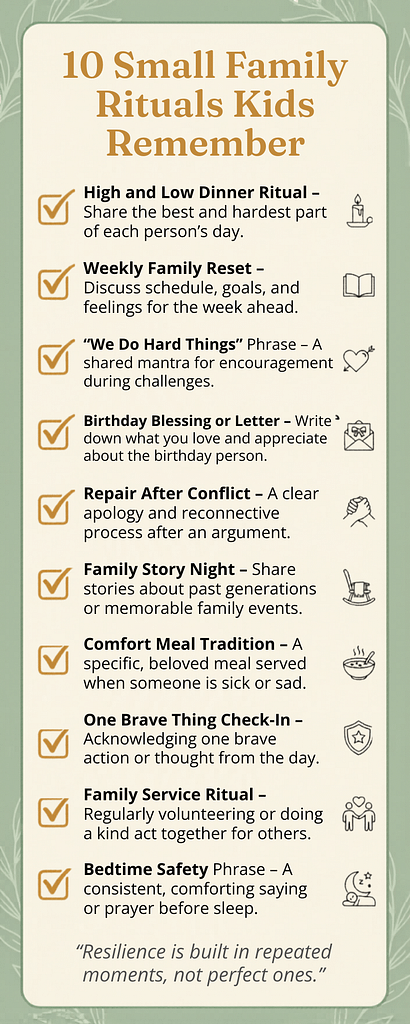
5. The “Repair After Conflict” Ritual
Every family argues. Parents lose patience. Siblings fight. Children talk back. Adults sometimes overreact.
The goal is not to create a home where conflict never happens. That is not realistic. The goal is to create a home where repair happens.
A repair ritual teaches children that relationships can bend without breaking.
This may sound like:
“I did not like how I spoke earlier. I am sorry.”
“Can we try that conversation again?”
“I was upset, but I still love you.”
“What do we need to do to make this right?”
This tradition is especially important because children learn emotional resilience not only from how families celebrate, but from how families recover.
Repair teaches humility, accountability, forgiveness, and emotional safety.
Try this:
After a tense moment, return when everyone is calmer and say, “Let’s reset. What happened, how did it feel, and what can we do differently next time?”
6. The “Family Story Night”
Children love stories, especially stories about their own family.
Tell them about:
- A time you failed and tried again
- A time you moved to a new place
- A time you were scared but kept going
- A funny family mistake
- How grandparents or relatives overcame challenges
- What life was like when you were their age
Family stories give children roots. They help children understand that struggle did not start with them, and survival did not either.
This is especially meaningful for families with cultural, immigrant, military, blended, or faith-based stories. Children benefit from knowing where they come from and what values have carried the family through change.
The stories do not have to be dramatic. Even a story about learning to ride a bike, starting a new school, or cooking a meal that went terribly wrong can teach resilience.
Try this:
Start with, “Did I ever tell you about the time I…”
Children may roll their eyes at first. Do not be discouraged. Some eye-rolls are just children secretly listening.
7. The Comfort Meal Tradition
Food is memory.
A comfort meal tradition could be Friday pasta, Sunday rice, rainy-day soup, pancake Saturdays, homemade pizza night, or a cultural dish passed down from family.
This ritual builds resilience because it creates warmth and continuity. During stressful seasons, familiar meals can make home feel steady.
The meal does not have to be fancy. In fact, the simpler it is, the easier it is to repeat.
You can also use the meal as a connection point. Let children help stir, wash vegetables, set the table, or choose the music. The tradition becomes less about the food and more about the togetherness around it.
Try this:
Choose one meal your family can repeat weekly or monthly and give it a name, such as “Reset Soup,” “Family Rice Night,” or “Saturday Pancake Club.”
A named tradition feels special, even when the ingredients are ordinary.
8. The “One Brave Thing” Check-In
Resilience grows when children learn to notice courage in small moments.
At the end of the week, ask each person:
“What is one brave thing you did this week?”
For a child, bravery may be:
- Asking a teacher for help
- Trying a new food
- Apologizing first
- Joining a game
- Sleeping alone
- Speaking in class
- Telling the truth
- Trying again after failing
This ritual helps children understand that courage is not only big and heroic. Sometimes courage is quiet, awkward, and unseen.
It also helps parents notice effort, not just results.
A child who did not win the match may have been brave enough to show up. A child who still struggled with math may have been brave enough to keep practicing.
Try this:
Share your own brave thing too. Children need to see that adults are still learning courage.
You might say, “My brave thing this week was making a phone call I was nervous about.”
That honesty helps children feel less alone.
9. The Family Service Ritual
Helping others builds perspective, gratitude, and emotional strength.
A family service tradition can be simple:
- Donating clothes together
- Checking on an elderly neighbor
- Writing thank-you notes
- Volunteering occasionally
- Preparing a meal for someone
- Picking up litter at the park
- Letting children choose a small cause to support
Service teaches children that they are not powerless. Even small acts can make a difference.
This matters because resilience is not only about personal toughness. It is also about connection, compassion, and purpose.
When children learn to contribute, they begin to see themselves as capable and needed.
Try this:
Once a month, ask, “Who can we help this month, and what small thing can we do?”
Keep it age-appropriate. A child does not need to solve world hunger before finishing primary school. Small kindness counts.
10. The Bedtime Safety Phrase
A bedtime phrase may seem tiny, but repeated words can become deeply comforting.
It might be:
“You are loved. You are safe. We will try again tomorrow.”
“Goodnight, my brave one.”
“No matter what happened today, I love you.”
“Tomorrow is a fresh start.”
Children often carry bedtime words into their inner voice. A calming phrase at night can help them process the day and rest with reassurance.
This is especially helpful after difficult days. If a child had a meltdown, got in trouble, argued with a sibling, or disappointed themselves, bedtime is a chance to remind them that love is not withdrawn.
Resilient children are not children who never make mistakes. They are children who know mistakes do not erase their worth.
Try this:
Choose one phrase and repeat it consistently. Let it become part of your family language.
How to Start a Family Tradition Without Overcomplicating It
The biggest mistake parents make with traditions is trying to create too many at once.
Start with one.
Choose something that fits your real life, not your fantasy life. A tradition you can repeat imperfectly is better than a beautiful idea that exhausts everyone.
Ask yourself:
What does my child need more of right now?
If they need emotional expression, try “high and low.”
If they need structure, try the weekly family reset.
If they need confidence, try the “one brave thing” check-in.
If the family has been tense, start with repair after conflict.
If everyone is busy and disconnected, begin with a comfort meal.
The best tradition is the one your family can actually keep. If you are already overwhelmed, start with one tiny ritual, because parent burnout can make consistency harder and the goal is connection, not another performance target.
What Kids Really Remember
Children may not remember every toy, every outing, or every carefully planned activity.
But they often remember the feeling of home.
They remember that Friday nights meant pizza and laughter.
They remember that someone asked about their day.
They remember the phrase you said when they wanted to quit.
They remember that after arguments, someone came back to repair.
They remember being celebrated for who they were, not just what they achieved.
Family traditions build resilience because they create repeated proof of love, belonging, and stability.
And the good news is this: you can begin small.
One question.
One phrase.
One meal.
One weekly reset.
One bedtime reminder.
That may not look like much in the moment, but childhood is built from repeated moments. Over time, those moments become memory. And sometimes, memory becomes strength.
Final Thought
You do not need to be a perfect parent to create meaningful traditions.
You only need to be intentional enough to repeat small acts of connection.
Because one day, your child may not say, “Thank you for building my resilience through predictable relational rituals.”
Children are not usually that academic at breakfast.
But they may say, “Remember how we always used to…?”
And that is when you will know it mattered.