

Parenting can be beautiful, funny, chaotic, sticky, loud, expensive, and emotionally demanding—sometimes all before 8 a.m.
One minute you are packing lunch, answering a school message, looking for a missing shoe, and reminding someone to brush their teeth. The next minute, you are wondering why everyone in the house knows how to create laundry but not how to put it away.
That kind of pressure is normal sometimes. But when stress becomes constant and there is no real recovery time, it can turn into burnout. Parental burnout is often linked with emotional exhaustion, feeling less effective as a parent, and emotional distancing from children. Research also shows that exhaustion can come first, then gradually lead to feeling detached or ineffective if nothing changes.
This check-in is not here to shame you. It is here to help you notice what your body, mind, and heart may already be trying to say: “I need support, not another lecture.”
What Is Parent Burnout?
Parent burnout is more than having a hard parenting day. It is the deep feeling of being emotionally, mentally, and physically drained by the ongoing demands of parenting.
It can happen to loving parents. It can happen to organized parents. It can happen to parents who look “fine” from the outside. Burnout does not mean you do not love your children. It often means you have been giving out more than you have been able to restore.
General burnout is commonly described as exhaustion, reduced motivation, lower performance, and negative feelings toward oneself or others. Although burnout is often discussed in workplace settings, health experts also recognize that prolonged stress in any area of life can affect mental and physical health.
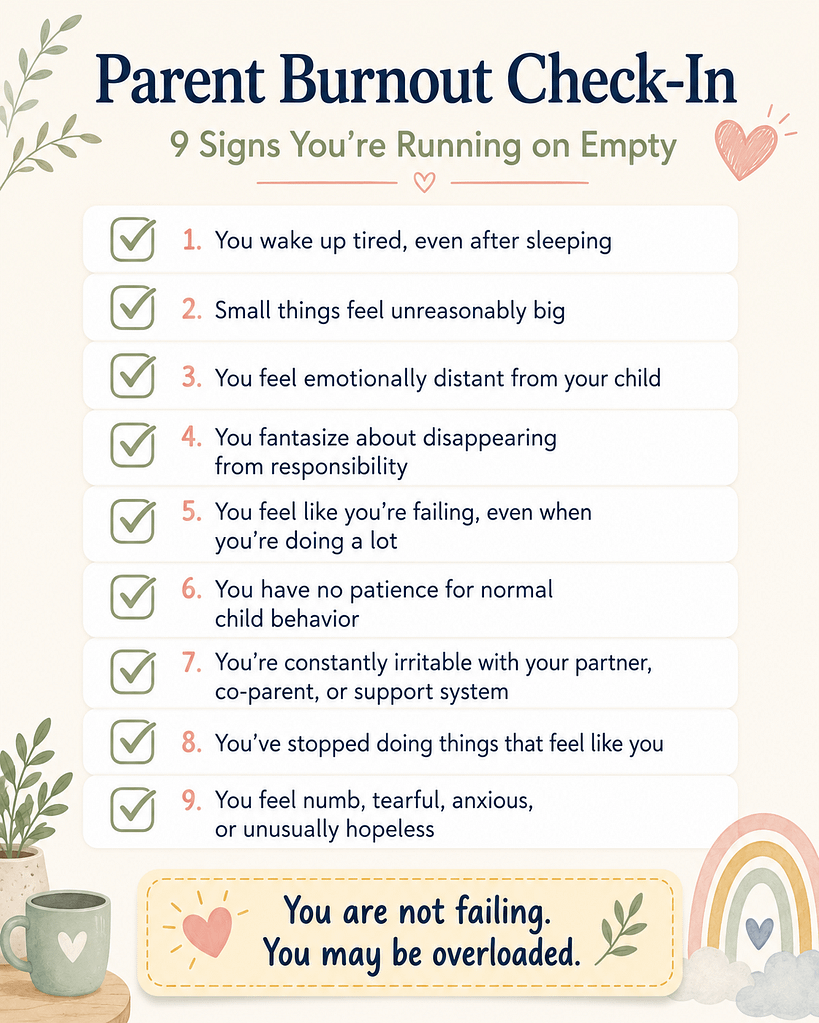
9 Signs You May Be Running on Empty
1. You wake up tired, even after sleeping
This is one of the biggest clues. You may technically sleep, but you do not feel restored. You wake up already bracing for the day.
You might think, “How is it morning again?” before your feet touch the floor. Your body is present, but your energy is still somewhere under yesterday’s pile of responsibilities.
What helps: Start with recovery, not perfection. Even 10 minutes of quiet before the day begins, a short walk, or going to bed without doing “one more thing” can begin to signal safety to your nervous system.
2. Small things feel unreasonably big
A spilled drink, a missing homework sheet, or a child asking the same question five times can feel like the final straw. You may react more strongly than the situation deserves, then feel guilty afterward.
This does not mean you are a bad parent. It may mean your emotional buffer is gone.
What helps: Use a pause phrase. Try: “I need one minute before I answer.” Then step away, breathe, drink water, or simply stand in another room. The goal is not to become a perfect calm parent overnight. The goal is to interrupt the pressure before it explodes.
3. You feel emotionally distant from your child
You may still do everything required—meals, school runs, baths, homework, appointments—but feel disconnected inside. You are functioning, but not fully present.
This can be confusing because outsiders may see a capable parent, while you know you are operating on autopilot. Research on parental burnout identifies emotional distancing as one of the important warning signs that can follow ongoing exhaustion.
What helps: Rebuild connection in small moments. You do not need a full family day out. Try five minutes of child-led attention: sit beside them, ask about their drawing, watch their game, listen to their story, or say, “I missed you today.” Small moments count.
4. You fantasize about disappearing from responsibility
You may not want to abandon your family, but you imagine being unreachable for a day. No meals. No questions. No school emails. No noise. No one calling “Mum!” or “Dad!” from another room as if the house is on fire.
That fantasy can be a signal that your mind is asking for relief.
What helps: Schedule real off-duty time, even if it is short. A 30-minute protected break is better than waiting for a magical free weekend that never comes. Put it on the family calendar like an appointment.
5. You feel like you are failing, even when you are doing a lot
Burnout can distort your self-view. You may focus only on what you did not do: the laundry still unfolded, the school form submitted late, the rushed dinner, the screen time you allowed because you needed silence.
Meanwhile, you ignore everything you did do.
What helps: Keep a “done list” instead of only a to-do list. Write down three things you handled today, however ordinary. “Fed everyone,” “answered school message,” and “did not shout during homework” are valid wins.
6. You have no patience for normal child behavior
Children are naturally repetitive, emotional, noisy, curious, slow, and sometimes unreasonable. Burnout makes normal child behavior feel unbearable.
A child needing help with shoes may feel like an attack on your peace. Setting healthy screen-time boundaries without constant battles
or a teenager’s attitude may feel like personal disrespect rather than a developmental phase that still needs boundaries.
What helps: Separate the child from the stress. Instead of “My child is the problem,” try “My system is overloaded.” This does not remove discipline or boundaries. It simply helps you respond from clarity instead of pure exhaustion.
7. You are constantly irritable with your partner, co-parent, or support system
Parent burnout can make every unequal task feel louder. If one parent carries most of the planning, remembering, booking, buying, cooking, cleaning, or emotional soothing, resentment can build quickly.
Sometimes the issue is not that no one helps. It is that one person has to manage the whole invisible checklist.
What helps: Ask for ownership, not “help.” Instead of saying, “Can you help with school stuff?” say, “Can you fully own school lunches this week, including checking what needs replacing?” Ownership reduces the mental load.
8. You have stopped doing things that feel like you
You may realize you no longer read, exercise, pray, journal, call friends, dress in a way that feels nice, listen to music, or enjoy hobbies. Your identity becomes “the person who gets everything done.”
Parenting requires sacrifice, but burnout often steals the whole person.
What helps: Reclaim one small identity habit. Not a full lifestyle transformation. Just one thing that reminds you, “I am still me.” That may be a 15-minute walk, a playlist, a devotional, a skincare routine, a gym class, or a weekly phone call with a friend.
9. You feel numb, tearful, anxious, or unusually hopeless
Burnout can overlap with anxiety or depression, so this sign deserves careful attention. If you feel persistently hopeless, unable to cope, emotionally numb, or like your family would be better off without you, that is not something to push through alone.
What helps: Speak to a health professional, therapist, GP, or trusted support service. If you ever feel at risk of harming yourself or someone else, seek urgent help immediately through local emergency services or a crisis line.
Needing help does not make you weak. It makes you human.
What Helps Parent Burnout? Practical Steps That Do Not Require a Perfect Life
Lower the standard where it does not matter
Not everything needs to be homemade, educational, organic, laminated, color-coded, and emotionally enriching.
Some nights, dinner can be eggs, toast, fruit, or leftovers. Some weekends, the activity can be “everyone rests.” Some seasons, your house may look lived in because people actually live there.
Lowering unnecessary standards is not failure. It is energy management.
Build recovery into the day, not only the weekend
Many parents wait for a big break that never comes. Recovery works better when it is small and repeated.
Try one of these:
- Sit in the car for three quiet minutes before going inside.
- Take a short walk after school drop-off.
- Put your phone down during one meal.
- Step outside and breathe before bedtime routines.
- Play calming music during the evening transition.
Short breaks may seem too simple, but they help your body understand that stress is not the only mode available.
Stop treating rest as something you earn
Parents often rest only when everything is finished. But parenting is never finished. There is always another dish, another email, another appointment, another sock looking for its long-lost partner.
Rest is not a reward for completing life. It is fuel for continuing it.
Use the “minimum viable parenting” method on hard days
On very low-energy days, ask: “What is the minimum my child needs today to be safe, fed, loved, and guided?”
That may mean:
- Basic meals, not perfect meals.
- Clean-enough clothes, not matching outfits.
- A calm bedtime, not an elaborate bedtime.
- One meaningful conversation, not constant entertainment.
Children do not need perfect parents. They need present-enough, repairing, loving parents.
Repair instead of drowning in guilt
You will sometimes snap. You will sometimes overreact. Every parent has moments they wish they handled better.
Repair matters.
Try saying:
“I was overwhelmed earlier, and I raised my voice. That was not your fault. I am sorry. I am working on calming my body before I speak.”
This teaches children accountability, emotional honesty, and relationship repair. It also reminds you that one bad moment does not define your parenting.
Share the invisible list
Many parents are not only tired from doing tasks. They are tired from remembering everything.
Write down the invisible work:
- School forms
- Appointments
- Meal planning
- Uniforms
- Snacks
- Birthday gifts
- Medicine
- Emotional check-ins
- Homework tracking
- Family calendar
- Household supplies
Then decide what can be delegated, deleted, simplified, automated, or delayed. If you co-parent, this list can help move the conversation from “I need more help” to “These are the responsibilities that need owners.”
Make connection simple again
When you are burned out, bonding can feel like another task. Keep it tiny.
Try:
- “Tell me one funny thing from today.”
- “Come sit with me for five minutes.”
- “Do you want a hug or space?”
- “Let’s make tea/hot chocolate together.”
- “I’m tired today, but I’m glad I’m your parent.”
Connection does not always need crafts, outings, or big emotional conversations. Sometimes it starts with sitting near each other without pressure.
A Simple Parent Burnout Check-In
Ask yourself these questions once a week:
- Am I sleeping but still exhausted?
- Am I reacting strongly to small things?
- Do I feel emotionally distant from my child?
- Do I feel resentful most days?
- Have I stopped doing things that make me feel like myself?
- Do I feel unsupported or overloaded?
- Am I relying on survival mode every day?
- Have I laughed with my child recently?
- Do I need practical help, emotional support, or professional guidance?
You do not need to answer perfectly. The point is awareness.
Final Thought: You Are Not a Machine
Parenting culture sometimes praises the exhausted parent as if constant sacrifice is the gold standard. But running on empty does not make you more devoted. It makes everything harder.
Your child benefits from a parent who is supported, rested when possible, emotionally honest, and willing to repair. You do not need to become a brand-new person. You may simply need fewer impossible expectations, more shared responsibility, and regular moments where you are allowed to breathe.
So here is the gentle check-in: What is one thing you can remove, reduce, delegate, or simplify this week?
Start there.