

When people hear the words career exploration, they often imagine teenagers choosing college majors or adults changing jobs. But career curiosity does not suddenly begin in high school. It starts much earlier, often in the preschool years, when children begin asking big questions like, “What does a doctor do?” “Who builds roads?” or “Can I be the person who makes video games?”
The good news is that you do not need a formal program, expensive kits, or pressure-filled conversations about the future to nurture that curiosity. What children need most is exposure, freedom to explore, and small chances to connect everyday life with real-world roles. That is where micro-experiments come in.
Micro-experiments are short, low-pressure activities that help children try on ideas, notice interests, and build confidence. They are not about deciding a future career at age five. They are about planting seeds. A child who explores, observes, asks questions, and reflects early is more likely to grow into a young person who feels capable of making informed choices later.
In this article, you will find 12 simple and practical micro-experiments that help children connect play, interests, and everyday experiences to the world of work. These ideas are designed to feel natural, flexible, fun and may reduce passive screen time.
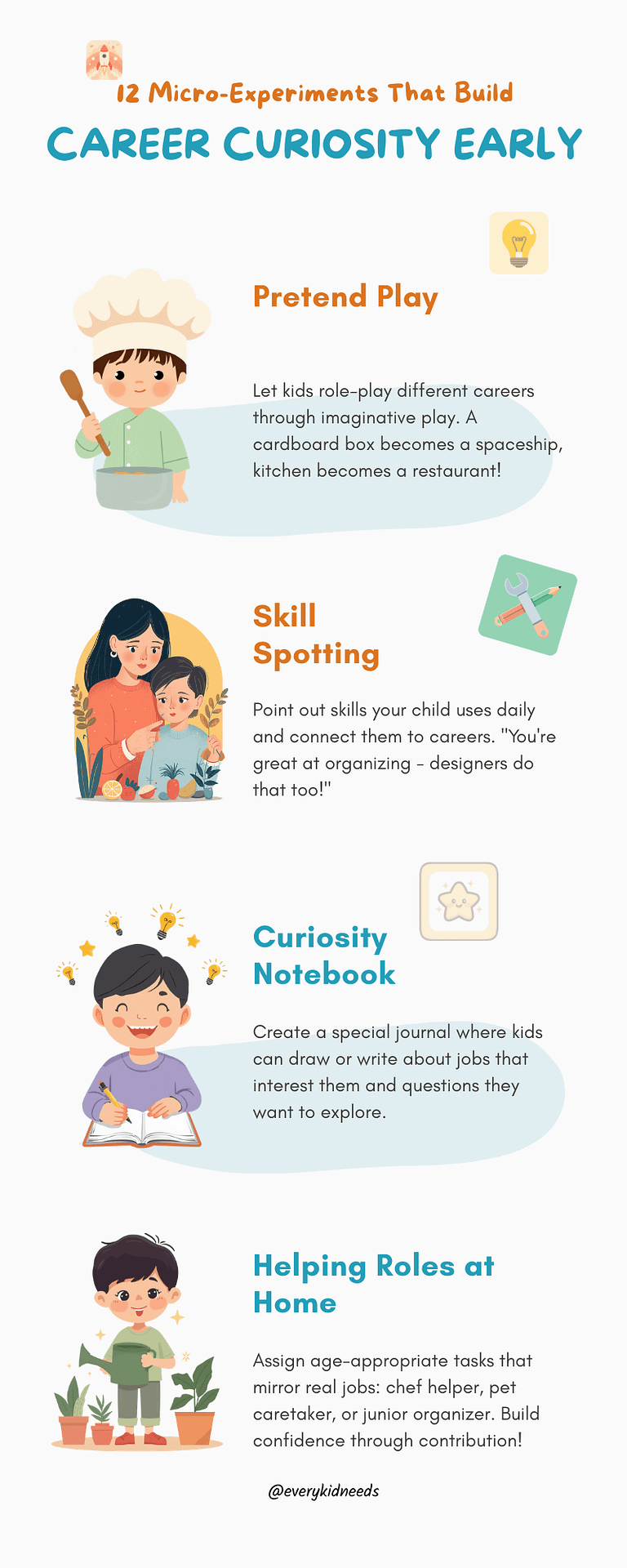
Why career curiosity matters early
Children are naturally curious, but that curiosity needs room to grow. When we help kids notice how different people solve problems, create things, care for others, lead teams, or work with tools, we expand their understanding of what is possible.
Early career curiosity can help children:
- develop confidence in their strengths
- connect learning to real life
- see value in many types of work
- build observation and problem-solving skills
- stay open-minded about future possibilities
It also helps reduce the narrow thinking that sometimes shows up early, where children assume only a few jobs matter or only certain people can do certain kinds of work.
The goal is not to ask, “What do you want to be?” over and over. The better question is, “What do you enjoy, notice, and want to learn more about?”
1. The “Who helps make this?” experiment
Pick one everyday item in your home, such as bread, a backpack, a toy, a toothbrush, or a phone charger. Ask your child, “Who helped make this possible?”
Then work backward together. For bread, you might talk about farmers, drivers, factory workers, bakers, designers, store managers, and cashiers. For a toy, you might mention inventors, engineers, artists, marketers, and delivery workers.
This small exercise helps children see that the world runs because many different people contribute in different ways.
Try it with: groceries, furniture, books, shoes, school supplies
2. One job, one question
Every week, choose one job and explore it through a single question. Keep it simple.
Examples:
- What does a pharmacist actually do all day?
- How does a pilot know where to go?
- Who writes the words in a cartoon?
- What does a plumber fix?
- How does a photographer tell a story?
You do not need a long lesson. A short chat, a picture book, a short video, or a quick observation in real life is enough. The goal is to make jobs feel real and accessible.
This works especially well because children often learn best through repeated small exposures rather than one big lecture.
3. Skill spotting during play
Watch your child during play and notice what skills naturally show up.
A child building towers may be showing early engineering thinking. A child organizing stuffed animals into a classroom may be exploring teaching or leadership. A child constantly drawing signs or menus may enjoy design, communication, or entrepreneurship.
Instead of saying only, “Good job,” try saying:
- “You really thought carefully about how to make that stable.”
- “You gave everyone a role. That is strong leadership.”
- “You noticed details other people might miss.”
This helps children connect what they enjoy doing with transferable strengths.
4. The mini workplace at home
Create a simple pretend “workplace” around your child’s interests. This does not need to be elaborate.
Examples:
- a pretend vet clinic with stuffed animals
- a mini bakery with play menus and orders
- a home design studio using paper and blocks
- a repair shop for broken toys
- a newsroom where your child interviews family members
The value is not in acting out job titles alone. It is in practicing communication, planning, empathy, creativity, and follow-through.
You may be surprised how much children reveal about their interests when they are given a role to step into.
5. The problem-solver challenge
Choose one tiny household problem and let your child help solve it.
Examples:
- How can we organize shoes better by the door?
- What is the fastest way to water the plants?
- How can we make snack time easier to prepare?
- What would make homework supplies easier to find?
This activity helps children see that many professions begin with one simple thing: someone noticed a problem and worked toward a solution.
It also introduces an important truth about work. Careers are not just jobs. They are often ways of solving problems for other people.
6. Shadow a task, not just a person
When people think of career exploration, they often think of job shadowing. For young children, it can be easier to shadow a task instead.
Let them observe:
- how a parent writes an email
- how a neighbor plants a garden
- how someone measures ingredients
- how a relative fixes a shelf
- how a shop worker arranges products neatly
Then ask:
- What did you notice?
- What looked easy?
- What looked hard?
- Would you like to try part of that?
This keeps the activity short and child-friendly while still building awareness.
7. The “tools of the job” game
Children are often fascinated by tools. Choose a job and explore the tools that person uses.
A chef uses knives, measuring cups, ovens, and timers. A builder may use levels, drills, tape measures, and safety gear. A nurse uses charts, thermometers, gloves, and monitors. A graphic designer uses software, sketchbooks, and tablets.
You can turn this into a guessing game:
“Which job uses these tools?”
Or:
“What kind of person might need this tool every day?”
This helps children connect objects, tasks, and roles in a memorable way.
8. Meet a worker in the wild
You do not need a formal interview. Real life gives children many chances to notice people at work.
At the library, grocery store, dentist’s office, mechanic shop, park, or post office, gently point out what people are doing. When appropriate, encourage your child to ask one polite question.
Examples:
- “What do you like most about your job?”
- “What is the hardest part?”
- “How did you learn to do that?”
Even one short exchange can make a profession feel human and reachable.
9. Create a “curiosity notebook”
Give your child a notebook for questions, observations, drawings, and ideas about work and interests. It can include:
- jobs they notice
- things they enjoy doing
- tools they find interesting
- questions they want answered
- things they tried and liked
For younger children, this can be picture-based. For older children, it can include simple reflections such as:
- I liked this because…
- I did not enjoy this because…
- I want to try this again.
Over time, the notebook becomes a record of growing self-awareness.

10. The one-day helper role
Let your child take ownership of one meaningful role at home for a day or a week.
Examples:
- family meal planner
- plant care helper
- bookshelf organizer
- pet care assistant
- laundry sorter
- event helper for a family gathering
The goal is not perfection. It is responsibility, contribution, and understanding that work often involves serving others, staying consistent, and learning by doing. It also offers simple ways to teach kids independence.
This is especially powerful because children begin to experience purpose, not just pretend it.
11. Interest mixing
Some children love more than one thing and assume they must choose. Help them see that interests can combine.
Try prompts like:
- What jobs mix art and technology?
- What jobs use science and helping people?
- What jobs combine writing and travel?
- What jobs involve sports and business?
- What jobs use computers and creativity?
This helps children understand that modern careers are often blended. A child who loves animals and photography, or baking and math, may one day find a role that brings both together.
This keeps curiosity open instead of boxed in.
12. Reflection after the experiment
After each micro-experiment, do not rush to label your child. Reflection matters more than conclusion.
Ask:
- What part did you enjoy most?
- What part was frustrating?
- Would you want to do that again?
- What did you learn about yourself?
- What surprised you?
These questions build self-knowledge, which is one of the most valuable skills a child can carry into later education and career decisions.
How to keep career curiosity healthy and pressure-free
It is easy for adults to overdo future-focused conversations. Children do not need the pressure of feeling that every interest must become a career path. They need room to explore without fear of getting it wrong.
A few simple reminders help:
Follow the child’s interest
If your child is fascinated by cooking, bugs, maps, music, machines, or storytelling, start there.
Keep it playful
The younger the child, the lighter the approach should be. Curiosity grows best when it feels enjoyable.
Avoid locking them in
Children change. Today’s obsession may fade, and that is normal.
Celebrate effort and discovery
The win is not choosing a dream job. The win is asking questions, trying things, and learning.
Expose them to many types of work
Children benefit from seeing creative, technical, caring, practical, hands-on, and community-based roles.
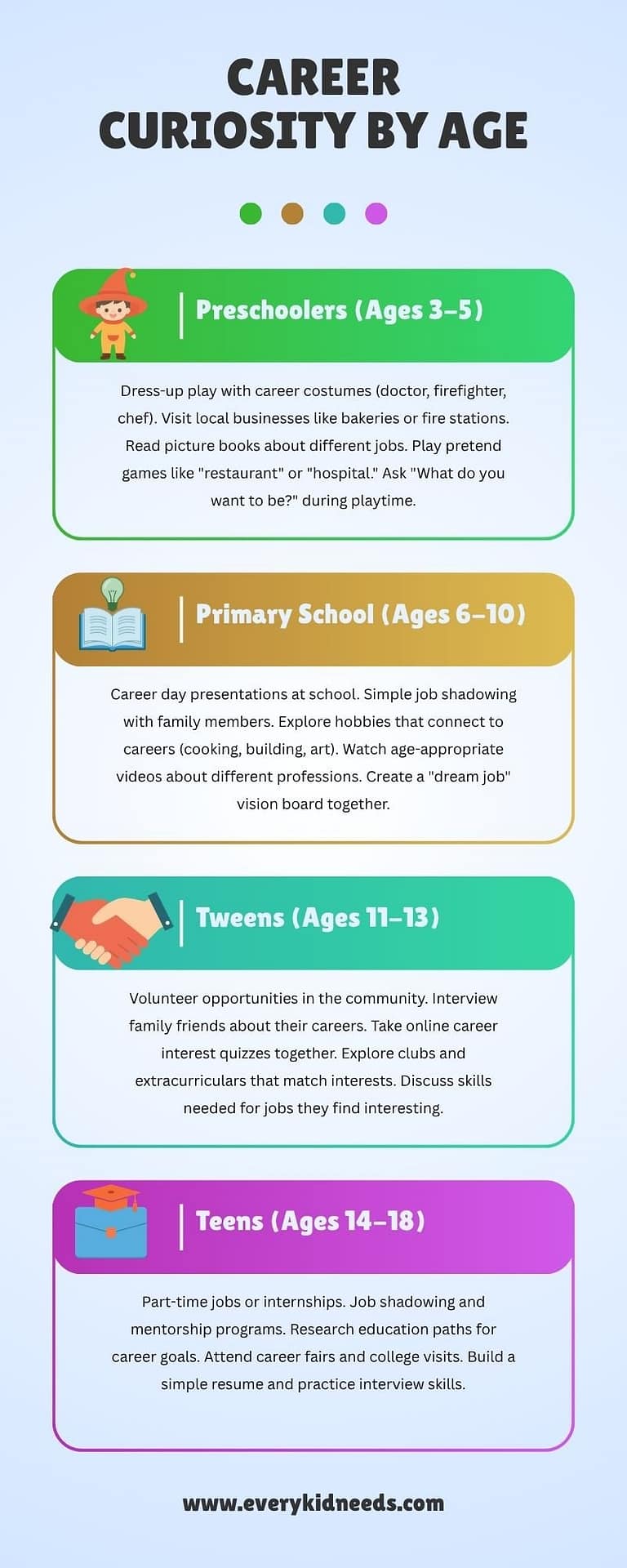
What this looks like by age
Career curiosity can look different at different stages.
Preschool
Pretend play, tools, uniforms, role-play, picture books, and simple questions
Early primary years
Observation, helping roles, drawing jobs, curiosity notebooks, and problem-solving activities
Later primary years
Mini interviews, simple research, beginner projects, volunteering, and skill spotting
Tweens and teens
Job shadowing, deeper interest mapping, real-world projects, entrepreneurship, and reflective conversations
The core idea stays the same: small experiences build awareness over time.
Final thoughts
Children do not need a five-year plan. They need chances to wonder, experiment, notice, and grow. A child who explores how people work, create, help, fix, design, teach, and lead begins to understand both the world and themselves a little better.
These 12 micro-experiments are simple, but they can have a lasting effect. They show children that the future is not one rigid path. It is a wide, interesting landscape full of possibilities.
And often, the path toward a meaningful profession begins with something very small: a question, a pretend game, a notebook page, or a child saying, “Can I try?”