
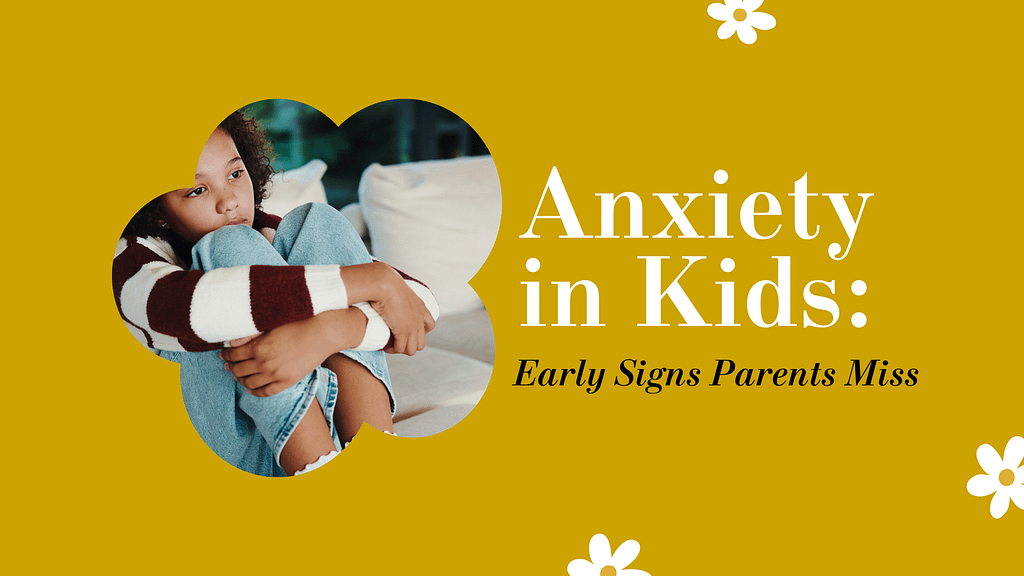
Your child says their stomach hurts again.
It is 7:35 on a school morning.
Yesterday, it was a headache.
Last week, they cried because they could not find the “right” socks. The night before a class presentation, they asked six times whether you were sure everything would be okay.
You may see tiredness, stubbornness, perfectionism, clinginess or another attempt to avoid school.
But underneath all of it, there may be something else happening:
Your child may be worried and may not yet know how to tell you.
That is one reason anxiety in kids can be surprisingly easy to miss.
Children do not always walk into the kitchen and announce, “I’m experiencing anxiety.”
Sometimes anxiety looks like a tummy ache.
Sometimes it looks like anger.
Sometimes it sounds like:
“What if?”
“Are you sure?”
“Can you stay?”
“Do I have to?”
And sometimes it looks like the child who appears to be doing perfectly well because they have quietly organised their life around avoiding anything that makes them uncomfortable.
Occasional worries are a normal part of childhood. The important difference is not simply whether a child worries, but whether fears become persistent, intense or begin interfering with school, sleep, friendships, play or everyday family life.
So instead of asking only:
“Does my child seem anxious?”
A more useful question may be:
“Has my child’s behaviour changed because they are trying to feel safer?”
That question can reveal things parents easily overlook.
What Anxiety in Kids Can Actually Look Like
Picture two children who are both nervous about school.
One says:
“I’m scared about tomorrow’s test.”
Most parents immediately recognise the worry.
The other child says:
“My stomach hurts. I’m not going.”
Then becomes furious when you insist they get dressed.
The second child may be described as difficult, oppositional or dramatic.
Yet both children may be experiencing anxiety.
Children can show anxiety through irritability, clinginess, sleep problems, difficulty concentrating, negative thoughts, avoidance and physical complaints such as stomach aches or headaches. Younger children may have particular difficulty identifying or explaining what they are feeling.
That does not mean every stomach ache is anxiety.
Or every angry child is anxious.
Or every child who dislikes school has an anxiety disorder.
The useful clue is usually the pattern.
What happens repeatedly?
When does it happen?
What seems to trigger it?
And what has your child started changing, avoiding or needing in order to cope?
Here are some of the early signs worth noticing.
1. The “Mystery” Tummy Ache That Has Surprisingly Good Timing
Children really do get stomach aches.
They really do get headaches.
So physical complaints should never automatically be dismissed as “just anxiety.”
But timing can tell you something.
Imagine your child frequently feels sick:
- Sunday evening
- before school
- before football practice
- before sleeping away from home
- before a presentation
- before visiting somewhere unfamiliar
…and then appears significantly better once the difficult event has passed.
That pattern deserves attention.
Anxiety can produce genuine physical sensations. Children may experience stomach discomfort, headaches, sweating, shaking, rapid heartbeat or other bodily symptoms when they feel worried.
The mistake is responding with:
“There’s nothing wrong with you.”
Your child may hear:
“What you’re feeling isn’t real.”
A better response is:
“Your tummy really does feel uncomfortable. I wonder if your body is also telling us that something about today feels hard.”
That keeps two possibilities open:
Their physical symptom matters.
And their emotions might matter too.
Try this at home: Become a pattern detective
For a week or two, quietly notice:
When does the complaint happen?
Not just what hurts.
You may discover:
“Tummy ache” appears mainly before school.
“Headache” appears before noisy social events.
“I’m tired” appears whenever your child has to perform in front of others.
That information is often more useful than repeatedly asking:
“Are you anxious?”
2. Anger That Seems Much Bigger Than the Situation
You tell your child you are leaving for a birthday party in ten minutes.
They suddenly explode.
They cannot find their favourite top.
Now they are shouting.
The shoes are wrong.
Their hair looks terrible.
They are not going.
You may naturally see disrespect or bad behaviour.
But sometimes anger is the visible layer sitting on top of worry.
A child may be thinking:
Who will be there?
What if nobody talks to me?
What if everyone looks at me when I arrive?
What if Mum leaves?
Those thoughts may never be spoken.
Instead, you get:
“I HATE THIS SHIRT!”
Irritability and angry outbursts can occur alongside childhood anxiety, particularly when children struggle to identify or communicate what they are experiencing.
This does not mean parents should ignore unacceptable behaviour.
You can hold the boundary and become curious about what is underneath it.
Try:
“You can’t shout at me like that. But this reaction feels bigger than the shirt. Is there something about the party you’re worried about?”
That sentence does two jobs.
It keeps the behavioural limit.
And it leaves the emotional door open.
3. The Child Who Needs You to Say “It Will Be Fine” Again and Again
Some anxiety does not look like panic.
It looks like questions.
Lots of them.
“Will you definitely pick me up?”
“Yes.”
“At three?”
“Yes.”
“You won’t forget?”
“No.”
“Promise?”
“I promise.”
“But what if you’re late?”
Reassurance feels helpful because it usually calms the child.
For five minutes.
Then the question comes back.
The issue may not be that your answer was unclear.
The child may be using your certainty to temporarily quiet their uncertainty.
You can still reassure them, but endless reassurance can become a cycle in which the child never gets to discover:
“I can cope even when I cannot know exactly what will happen.”
Try this at home: Answer once, then build coping
Instead of answering the same “what if?” question ten different ways, try:
“We’ve talked about the plan, and you know what will happen. Now let’s think about what you can do if you start feeling worried.”
Then create a small coping plan.
For example:
If Mum is five minutes late: stay with the teacher.
If I feel nervous before the test: take three slow breaths and start with the easiest question.
If I don’t know anyone at the party: find one person I recognise and say hello.
The goal is gradually shifting the child from:
“Promise nothing uncomfortable will happen.”
to:
“If something uncomfortable happens, I have a way to handle it.”
That is a much more powerful kind of reassurance.
4. Perfectionism That Looks Like Being “Such a Good Student”
This one can hide particularly well.
The child gets good grades.
Remembers everything.
Checks their homework repeatedly.
Hates making mistakes.
Practises until something is perfect.
Adults may praise them as conscientious.
And they may indeed be conscientious.
But sometimes perfectionism is less about loving excellence and more about fearing what will happen if something goes wrong.
Listen for phrases such as:
“I can’t hand this in. It isn’t good enough.”
“What if I get one wrong?”
“Everyone else will be better than me.”
“I need to start again.”
A useful distinction is what happens after a mistake.
A child striving in a healthy way may be disappointed, learn something and continue.
An anxious perfectionist may experience an ordinary mistake as evidence of catastrophe, embarrassment or personal failure.
Try the “good enough” experiment
Choose something low stakes.
A drawing.
A homemade card.
A weekend baking project.
A small homework task that does not require endless polishing.
Practise stopping when it is good enough.
Then say:
“You noticed something you would change, and you still finished it. That’s a useful skill.”
Praise flexibility, recovery and effort—not only the finished result.
Children need opportunities to discover that imperfect things can still end safely.
5. Avoidance That Looks Like Preference
This may be the biggest sign parents miss.
Your child does not say:
“Social situations make me anxious.”
They say:
“I don’t like parties.”
They do not say:
“I’m scared I’ll get the answer wrong.”
They say:
“I hate maths.”
They do not say:
“Separating from you makes me frightened.”
They say:
“I don’t want to go.”
Avoiding uncomfortable situations can bring immediate relief.
And that relief can make avoidance very tempting the next time.
The NHS notes that anxiety can become particularly concerning when children increasingly avoid everyday activities, school, social situations or things they would ordinarily be expected to do.
This creates a parenting dilemma.
You do not want to throw a frightened child into the deep end.
But completely restructuring life around every fear may make the child’s world smaller and smaller.
The middle ground is often small, supported steps.
If a child is frightened of joining an after-school club, the first step might not be:
“Go in alone for two hours.”
It might be:
“We’ll walk in together and stay for ten minutes.”
Then:
“You stay for twenty minutes while I’m nearby.”
Then:
“You stay for the whole session.”
Gradually facing manageable fears, with appropriate support, can help children build confidence rather than organising life entirely around avoidance.
6. Bedtime Suddenly Becomes a Two-Hour Negotiation
“One more drink.”
“I need the toilet.”
“Check the wardrobe.”
“Can you leave the hallway light on?”
“Can you stay until I fall asleep?”
“I just remembered something I need to tell you.”
Bedtime can be the first quiet moment of a child’s day. A calmer evening routine can also help children transition away from stimulating activities and screens before sleep. And quiet gives worries room to speak.
A child who seemed fine at 4 p.m. may suddenly remember:
Tomorrow’s spelling test.
Something another child said at lunch.
Whether Grandma might get sick.
A scary story they heard.
Something they saw online.
Sleep difficulty and waking during the night can be associated with anxiety in children.
Create a “worry closing time”
Try giving worries a predictable place before bedtime.
Perhaps 15 minutes after dinner.
Ask:
“Anything your brain keeps bringing back today?”
Your child can talk, draw or write it down.
For younger children, create a “worry box.”
Then when worries arrive at bedtime:
“That’s one for tomorrow’s worry time. We don’t have to solve it tonight.”
This does not magically turn anxiety off.
But it helps separate having a worry from needing to solve every worry immediately.
7. Your Child Suddenly Wants You to Do Things They Used to Do Themselves
“Come upstairs with me.”
“Order for me.”
“Tell the teacher.”
“Can you ask?”
“Don’t leave yet.”
Occasional dependence is normal.
Children move back and forth between independence and needing comfort, particularly during change.
But notice when your child begins giving up independence they previously handled comfortably.
Perhaps they used to walk into football practice alone.
Now you have to accompany them.
They previously spoke to the cashier.
Now they refuse.
They slept independently.
Now they repeatedly come into your room.
The individual behaviour is less important than the direction of travel.
Ask:
Is my child’s world expanding, staying roughly stable, or becoming smaller because of fear?
That is often a much more revealing question than:
“Is this normal for their age?”
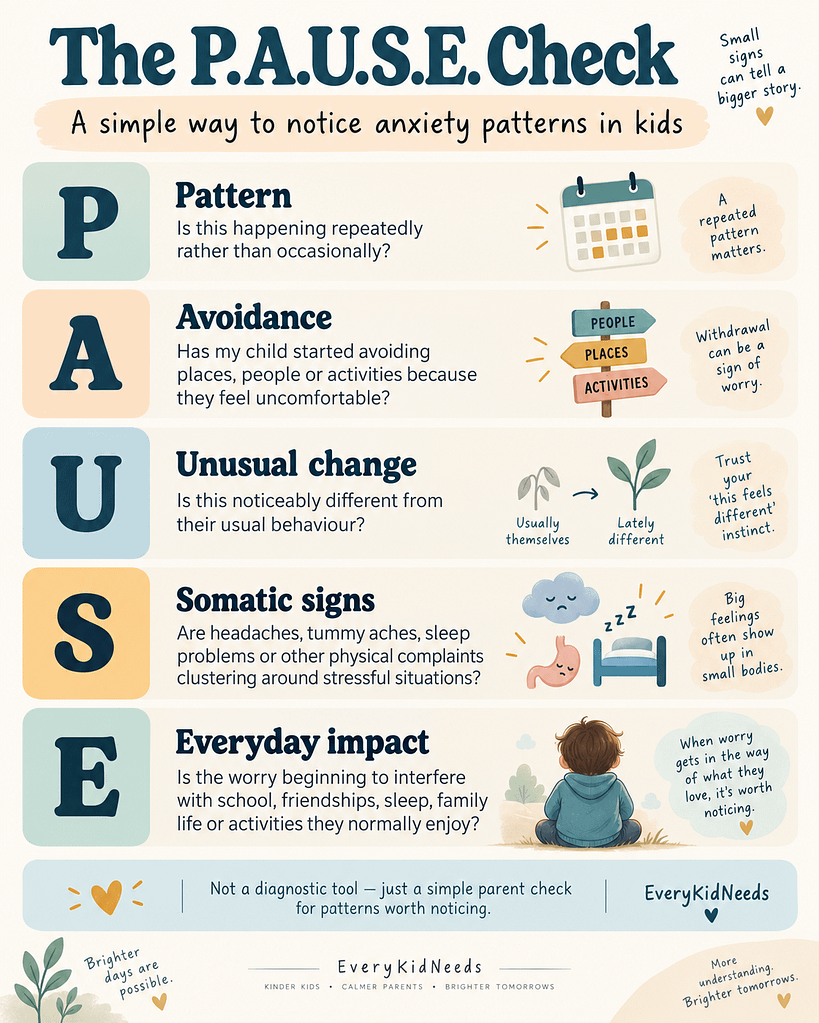
The EveryKidNeeds P.A.U.S.E. Check
You do not need to diagnose your child.
But you can become a better observer.
When something feels different, use this simple check:
P — Pattern
Is this happening repeatedly rather than occasionally?
A — Avoidance
Has my child started avoiding places, people or activities because they feel uncomfortable?
U — Unusual change
Is this noticeably different from their usual behaviour?
S — Somatic signs
Are headaches, tummy aches, sleep problems or other physical complaints clustering around stressful situations?
E — Everyday impact
Is the worry beginning to interfere with school, friendships, sleep, family life or activities they normally enjoy?
One sign on one difficult Tuesday does not tell you much.
Several signs forming a pattern over time tell you much more.
What Parents Can Do at Home
Once you notice anxiety, the instinct is often to make it disappear.
But consider changing the goal.
Instead of:
“How do I stop my child feeling anxious?”
try:
“How do I help my child learn what to do when anxiety shows up?”
That creates a different kind of parent response. Helping children name what they feel is also part of developing healthy emotional and relationship skills.
Name what you notice without assigning a diagnosis
Try:
“I’ve noticed school mornings have been feeling harder lately.”
Instead of:
“You’re an anxious child.”
Or:
“You clearly have anxiety.”
Describe the experience without turning it into the child’s identity.
Validate the feeling without confirming the fear
There is an important difference between:
“I can see that you’re really worried about the test.”
and:
“You’re right. That test sounds terrifying.”
The first validates your child.
The second may accidentally validate the threat.
You can say:
“It makes sense that you feel nervous about something important. I also believe you can handle feeling nervous.”
Children need both parts:
I believe your feeling.
And:
I believe in your ability to cope with it.
Give worries a name
For younger children, externalising anxiety can help.
Maybe it is:
“The Worry Alarm.”
“The What-If Voice.”
“The False Alarm.”
When the child says:
“What if nobody wants to play with me?”
you can respond:
“That sounds like your What-If Voice giving you a scary prediction. What do we actually know?”
The purpose is not to ridicule the worry.
It is to help the child realise:
A thought can feel convincing without being a fact.
Use a 3-step “What If?” plan
When your child gives you a frightening possibility, resist immediately saying:
“That won’t happen.”
Instead try:
1. What are you worried might happen?
“I’ll forget my lines.”
2. What is most likely to happen?
“I might forget one part, but I’ll probably remember most of it.”
3. What could you do if the worry actually happened?
“Pause, look at my cue card and continue.”
Now anxiety has somewhere to go.
The child has moved from catastrophe to coping.
Keep predictable routines where possible
Children cannot control very much of their world.
Predictable mealtimes, bedtime routines, school preparation and family rhythms can give them useful anchors.
The NHS and American Academy of Pediatrics both recommend predictable routines among practical ways families can support anxious children.
This does not require running your home like a military operation.
It simply means that when life feels uncertain, some things remain reassuringly ordinary.
Teach one calming skill before it is needed
Trying to teach breathing exercises during a full meltdown is like introducing swimming lessons after someone falls into the pool.
Practise while calm.
Try three slow breaths together.
Breathe in gently.
Then make the exhale slightly longer.
Or help your child notice:
5 things I can see
4 things I can touch
3 things I can hear
2 things I can smell
1 thing I can taste
The point is not convincing the child that anxiety is gone.
It is giving their body something useful to do while the feeling passes.
One Thing Parents May Need to Stop Doing
When a child is anxious, loving parents naturally begin removing obstacles.
You speak for them.
Cancel the activity.
Let them stay home.
Check everything repeatedly.
Promise nothing bad will happen.
Sleep beside them every night.
And sometimes accommodation is completely reasonable.
But ask yourself:
Am I helping my child through the difficult thing—or helping them never encounter it?
Those are not always the same.
The aim is not to withdraw support.
It is to gradually change support from:
“I’ll make sure you never feel uncomfortable.”
to:
“I’ll help you discover that you can handle uncomfortable feelings.”
That is a much more durable gift.
When Home Support Is Not Enough
Parents should not feel they need to manage significant anxiety alone.
Consider speaking with your child’s GP, paediatrician, school or another qualified health professional when worries are persistent, worsening or significantly affecting everyday life—for example, school attendance, friendships, sleep, eating, activities or family functioning. Both the NHS and CDC recommend seeking professional support when anxiety becomes severe or interferes with normal daily life.
You also do not need to wait until things become unbearable before raising a concern.
Early support can simply begin with:
“I’ve noticed a pattern in my child’s behaviour and I’d like some guidance.”
And remember that physical symptoms such as persistent headaches, stomach pain or other health changes deserve appropriate medical assessment rather than being automatically attributed to anxiety.
What Progress Actually Looks Like
Parents sometimes expect improvement to mean:
“My child is no longer anxious.”
But progress may look more like:
They still feel nervous before school—but they go.
They still ask whether the presentation will be difficult—but only once instead of ten times.
They still want you near the birthday party—but you can now wait outside.
They make a mistake—and recover in five minutes rather than abandoning the entire task.
They say:
“I’m worried.”
instead of:
“My stomach hurts and I’m never going back.”
That is progress.
Confidence is not always the absence of fear.
Sometimes confidence is a child slowly learning:
“I’ve felt this before. I know what to do.”
A Simple 7-Day Parent Observation Experiment
If you are unsure whether you are seeing an anxiety pattern, spend one week observing rather than interrogating.
Each time something happens, mentally note four things:
What happened just before it?
What did my child do?
What seemed to help?
What did they avoid afterward?
You may discover something surprisingly specific.
The meltdowns happen before transitions.
The stomach aches happen on PE days.
The repeated questions begin whenever plans are uncertain.
The bedtime problems are worse before Mondays.
The perfectionism appears mostly around one particular subject.
That gives you something much more useful than:
“My child is always anxious.”
Now you have a pattern you can respond to.
And if you decide to seek professional support, those observations can help you clearly explain what you have been seeing.
The Goal Is Not to Raise a Child Who Never Worries
Worry has a purpose.
It alerts us.
It prepares us.
It tells us when something matters.
Children do not need to grow up believing that every uncomfortable feeling is dangerous or must immediately disappear.
They need to gradually learn:
I can notice a worried thought without automatically believing it.
I can feel butterflies and still walk through the door.
I can ask for help without giving up.
I can make a mistake without everything falling apart.
And perhaps most importantly:
I can tell someone when something feels too hard.
Parents cannot remove every worry from childhood.
But we can create homes where worries are allowed to be spoken, where feelings are taken seriously without being allowed to run the entire family, and where children repeatedly experience themselves doing difficult things with support.
That is how courage grows.
Not because fear never arrives.
But because eventually a child begins to understand:
“Feeling worried doesn’t mean I can’t do it.”
EveryKidNeeds Takeaway
When you suspect anxiety, remember:
Notice the pattern → Name the feeling → Validate without feeding the fear → Make a coping plan → Take one manageable step → Watch how daily life is being affected.
Your job is not to guarantee your child a worry-free childhood.
It is to help them develop the skills, language and confidence to meet worry when it appears.
And that is something every kid needs.
Frequently Asked Questions
What are the first signs of anxiety in a child?
Early signs can include repeated worries, irritability, clinginess, trouble sleeping, difficulty concentrating, avoidance, frequent reassurance-seeking and physical complaints such as headaches or stomach aches. A single symptom does not necessarily indicate anxiety; patterns, persistence and interference with everyday life matter.
Can anxiety in children look like anger?
Yes. Some children become irritable or have angry outbursts when overwhelmed by worry, particularly if they cannot easily identify or communicate what they are feeling.
Can anxiety cause stomach aches in children?
Anxiety can be associated with genuine physical symptoms, including stomach discomfort and headaches. However, persistent or concerning physical symptoms should be appropriately evaluated rather than automatically assumed to be psychological.
Should I let my child avoid things that make them anxious?
It depends on the situation. For ordinary fears, repeatedly avoiding everything uncomfortable can prevent a child from learning that they can cope. Small, gradual and supported steps are often more helpful than either forcing a frightened child into a situation or eliminating every challenge.
When should parents seek professional help for childhood anxiety?
Consider professional support when anxiety is persistent, worsening or interfering with school, friendships, sleep, family life or normal activities. A GP, paediatrician, school professional or qualified mental health professional can help determine appropriate next steps.