
There comes a point in parenting when constant policing stops working.
You can remind your teen to sleep earlier, eat better, put the phone down, move their body, drink water, study, clean their room, and stop scrolling at midnight. You can say it calmly. You can say it loudly. You can say it with that special parent voice that means, “I am trying very hard not to lose my patience.”
And still, your teen may look at you like you are the background noise of their life.
This does not mean you have failed. It means your parenting strategy needs to grow with your child.
Teenagers are moving toward independence. They want more control over their bodies, schedules, friendships, phones, schoolwork, and choices. That desire for freedom is normal. The problem is that freedom without structure can quickly become chaos, while structure without freedom can feel like prison.
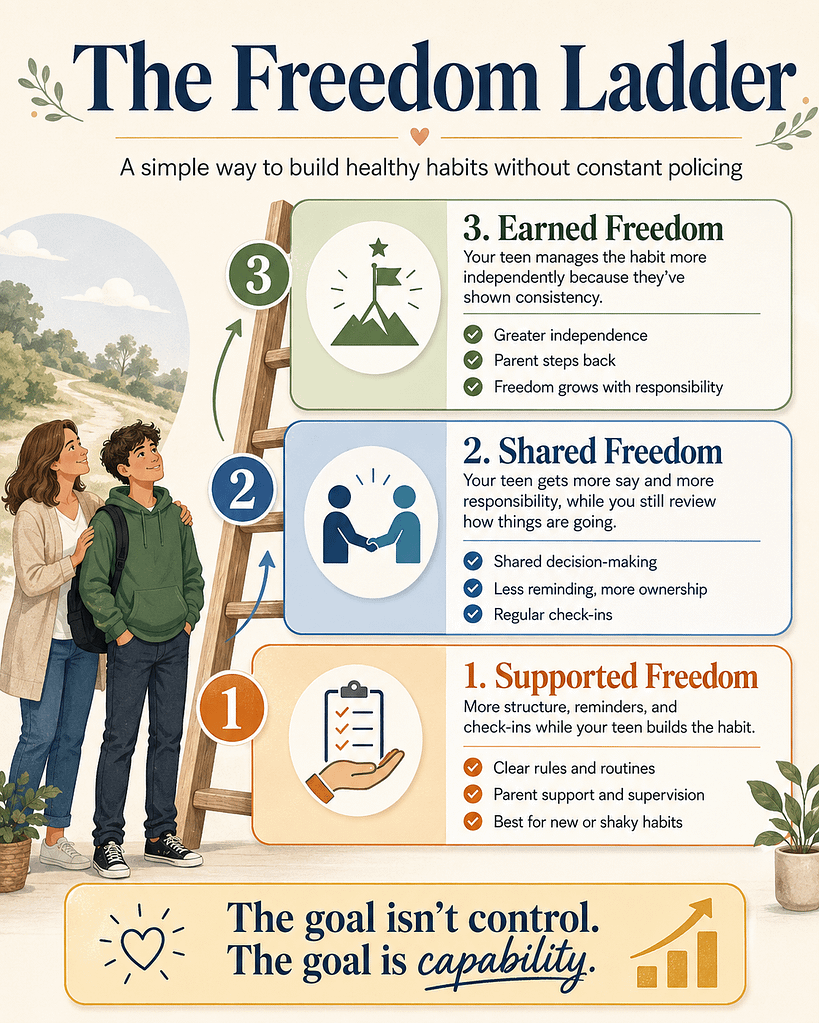
That is where the Freedom Ladder comes in.
Instead of constantly policing your teen’s healthy habits, you gradually hand over responsibility in stages. Your teen earns more freedom by showing they can handle it. You are not removing boundaries. You are turning boundaries into a training system.
The goal is not to raise a teen who obeys only when watched.
The goal is to raise a young person who can make healthy decisions when you are not in the room.
What Is a Freedom Ladder?
A Freedom Ladder is a simple parenting approach where independence increases step by step.
Your teen does not get unlimited freedom all at once. They also do not stay trapped under constant adult control forever. Instead, they climb levels of responsibility.
Each level answers three questions:
- What healthy habit are we working on?
- What freedom can my teen manage right now?
- What evidence shows they are ready for more?
For example, instead of saying, “You are always on your phone, so I’m taking it away,” a Freedom Ladder might sound like:
“You can manage your phone in your room until 9:30 p.m. this week. If you are waking up on time, getting enough sleep, and not using it during homework, we can review whether that time moves later.”
That is not permissive parenting. It is guided independence.
It gives your teen a path forward.
Why Constant Policing Often Backfires
Policing can create short-term compliance, especially with younger children. But as children become teens, constant monitoring can lead to secrecy, resentment, arguments, or learned helplessness.
A teen who is always controlled may not learn how to self-regulate. They may simply learn how to avoid being caught.
Healthy habits require internal motivation. Sleep, nutrition, exercise, hygiene, school routines, and digital boundaries all work better when teens understand why they matter and have some ownership in the process.
The American Academy of Pediatrics encourages families to support healthy routines through balance, modelling, and family plans, especially around media use, sleep, movement, and screen-free time. Recent AAP guidance also emphasizes digital literacy, caregiver modelling, and creating screen-free opportunities for sleep, reading, movement, homework, and family time.
In other words, the aim is not simply “control the teenager.”
The aim is to build a home environment where healthy decisions become easier to practise.
The Key Mindset Shift: From “I Control You” to “I Coach You”
The Freedom Ladder works best when parents see themselves less as police officers and more as coaches.
A police officer watches for rule-breaking.
A coach teaches skills.
A police officer says, “You broke the rule.”
A coach says, “What happened, what did you learn, and what needs to change before you are ready for the next level?”
This does not mean you ignore bad choices. It means consequences become connected to growth.
For example:
- If your teen stays up too late scrolling, the phone may charge outside the bedroom for a while.
- If they manage sleep well for two weeks, they may earn more evening phone flexibility.
- If they skip chores repeatedly, they may need a written plan before getting weekend privileges.
- If they handle responsibilities consistently, you step back.
This teaches a powerful life lesson: freedom and responsibility travel together.
Why Teens Need Both Autonomy and Boundaries
Teenagers are not small adults, but they are also not little children. They are in a transition stage.
They need room to practise decision-making, but they still need adult support. Research and child-development guidance consistently point to the importance of supportive adult relationships, self-regulation skills, and a sense of control in helping young people become resilient. Harvard’s Center on the Developing Child identifies supportive adult-child relationships, self-efficacy, adaptive skills, and the ability to draw on sources of hope and support as key factors in resilience.
That fits the Freedom Ladder perfectly.
Your teen needs to feel, “My parents trust me to grow.”
But they also need to know, “My parents will step in if I am not handling something well.”
This balance protects both health and relationship.
How to Build a Freedom Ladder for Healthy Teen Habits
You can use the Freedom Ladder for almost any healthy habit, but it works especially well for sleep, screens, food, exercise, chores, school routines, hygiene, friendships, and money.
Here is the basic structure.
Step 1: Choose One Habit at a Time
Do not try to fix everything in one weekend.
That is how peaceful family meetings turn into courtroom dramas.
Start with one habit that is causing the most stress or has the biggest impact on your teen’s wellbeing. For many families, the first habit is sleep, phone use, homework routines, or basic responsibility.
Ask yourself:
- Is this habit affecting my teen’s health?
- Is it causing daily conflict?
- Is it something my teen can realistically improve?
- Can we measure progress without turning the house into a surveillance operation?
Start small. A teen who feels attacked in every area may resist in every area.
A teen who is invited to work on one clear habit may be more willing to participate.
Step 2: Define the Non-Negotiable
Freedom does not mean everything is up for debate.
Some rules are non-negotiable because they involve safety, health, respect, or family values.
For example:
- Devices are not used while driving.
- A parent must know where the teen is going.
- Sleep cannot be regularly sacrificed to gaming or scrolling.
- Family members speak respectfully, even during disagreement.
- Substances, unsafe online behaviour, and dangerous peer situations require firm boundaries.
The non-negotiable should be clear and limited. If everything is non-negotiable, nothing feels fair.
A good phrase is:
“I’m willing to discuss the method, but not the safety standard.”
For example, your teen may help decide where the phone charges at night, but they may not get unlimited overnight phone use if it is harming sleep.
Step 3: Create Three Levels of Freedom
A simple Freedom Ladder can have three levels:
Level 1: Supported Freedom
This is for a teen who is still learning the habit or has recently struggled with it.
Parents provide more structure, reminders, and check-ins.
Example:
“You can use your phone after homework, but it charges downstairs at 9:30 p.m.”
Level 2: Shared Freedom
This is for a teen who is becoming more consistent.
Parents step back slightly, but expectations remain clear.
Example:
“You can keep your phone until 10 p.m. if homework is complete and mornings are going smoothly.”
Level 3: Earned Freedom
This is for a teen who has shown responsibility over time.
Parents monitor less and trust more.
Example:
“You manage your phone time during the week. If sleep, school, mood, or responsibilities start slipping, we revisit the plan.”
The ladder should be visible, simple, and discussed calmly.
The message is not, “I am waiting for you to mess up.”
The message is, “I want you to grow into more freedom, and this is how we will know you are ready.”
The Freedom Ladder in Real-Life Teen Habits
Now let’s make this practical.
Here are common healthy habit areas where the Freedom Ladder can help.
1. Sleep: More Than “Go to Bed Earlier”
Teen sleep can become a nightly battle.
Parents say, “Go to bed.”
Teens say, “I’m not tired.”
Parents say, “You’ll be tired tomorrow.”
Teens say, “I know.”
Everyone repeats the same script until the house is annoyed and nobody is sleeping.
But sleep is one of the most important healthy habits for teens. The American Academy of Pediatrics notes that teens ages 14–17 should aim for 8–10 hours of sleep per night, and screen use before bed can affect sleep quality by increasing alertness and delaying the body’s sleep signals.
Instead of only policing bedtime, create a sleep Freedom Ladder.
Level 1: Supported Sleep
- Phone charges outside the bedroom.
- Parent and teen agree on a wind-down time.
- Caffeine is limited later in the day.
- Homework and screen use are separated from bedtime where possible.
- Parent checks in briefly before bed.
Level 2: Shared Sleep
- Teen chooses their wind-down routine.
- Phone may stay nearby until an agreed time.
- Parent checks morning outcomes: waking up, mood, school readiness.
- Weekend sleep-ins are allowed within reason.
Level 3: Earned Sleep Freedom
- Teen manages bedtime more independently.
- Parent focuses on outcomes, not micromanaging every minute.
- If sleep debt returns, the family temporarily moves down a level.
The key is to measure the real issue: not whether your teen obeys a bedtime perfectly, but whether they are rested enough to function.
Ask:
“Are you waking up on time?”
“Are you constantly exhausted?”
“Is your mood worse when you sleep less?”
“What routine helps you actually fall asleep?”
This turns sleep into a life skill, not just another argument.
2. Screens: Replace Phone Wars With Phone Readiness
Most parents do not want to fight about phones every day.
And yet many do.
Screens are tied to friendship, entertainment, school, identity, boredom, stress relief, and social pressure. That is why “just put it down” rarely works as a full strategy.
The AAP recommends family media plans and encourages families to build healthy digital habits, including screen-free time for sleep, movement, reading, homework, and family connection.
A Freedom Ladder helps teens learn digital self-control.
Level 1: Supported Screen Use
- Devices charge in a shared space overnight.
- No phone during meals, homework blocks, or family conversations.
- Parent uses parental controls if needed.
- Social media apps may have time limits.
Level 2: Shared Screen Use
- Teen helps set app limits.
- Teen can manage some entertainment time after responsibilities.
- Parent and teen review screen habits weekly.
- Parent asks about online mood, not just screen minutes.
Level 3: Earned Digital Freedom
- Teen manages most screen use independently.
- Parent still reserves the right to step in if sleep, school, mental health, or safety is affected.
- Teen shows they can take breaks without a major battle.
A useful question is:
“Is your phone serving your life, or is your life being squeezed around your phone?”
That question invites reflection. It is better than “You are addicted to that thing,” which usually invites defensiveness.
3. Food: Teach Fuel, Not Shame
Teen eating habits can be sensitive.
Bodies are changing. Appetites fluctuate. Peer pressure increases. Some teens eat constantly. Some skip meals. Some become self-conscious about weight, skin, sports performance, or body image.
So the goal should not be food policing.
The goal should be helping teens understand nourishment, energy, and balance without shame.
The CDC notes that healthy eating supports teen growth, wellbeing, immunity, brain health, and cognition.
A food Freedom Ladder may look like this:
Level 1: Supported Food Habits
- Parent provides regular meals and snacks.
- Teen eats breakfast or takes a realistic alternative.
- Sugary drinks and ultra-processed snacks are limited at home without moral lectures.
- Parent avoids body-shaming comments.
Level 2: Shared Food Habits
- Teen helps plan simple meals or school lunches.
- Teen chooses healthy snacks they actually like.
- Teen learns basic cooking skills.
- Parent teaches “add something helpful” rather than “never eat that.”
For example:
“Add protein.”
“Add fruit.”
“Add water.”
“Add something that keeps you full.”
Level 3: Earned Food Independence
- Teen can prepare basic meals.
- Teen understands how food affects energy, mood, sports, sleep, or concentration.
- Parent trusts more choices while keeping the home food environment supportive.
A practical rule is:
Do not make every snack a sermon.
Teens need guidance, but they also need a healthy relationship with food.
4. Movement: Make Exercise Less Like Punishment
Not every teen loves sport.
Some teens hate PE. Some feel embarrassed exercising. Some are tired, anxious, busy, or glued to screens. Others enjoy movement but only when it does not feel forced.
The CDC recommends that children and adolescents get regular physical activity, and national guidance generally points to about 60 minutes or more of moderate-to-vigorous physical activity daily for school-aged children and teens.
But telling a teen “you need exercise” can sound like criticism.
Try framing movement as energy, stress relief, strength, and mood support.
Level 1: Supported Movement
- Parent invites teen for short walks.
- Movement is tied to something enjoyable: music, friends, dog walking, basketball, dancing, cycling, gym, swimming, martial arts, or active games.
- Family reduces all-or-nothing expectations.
Level 2: Shared Movement
- Teen chooses two or three movement options they do not hate.
- Parent helps with transport, equipment, or scheduling.
- Teen tracks how movement affects mood or sleep.
Level 3: Earned Movement Independence
- Teen builds movement into their week.
- Parent stops nagging daily and checks in occasionally.
- Teen can explain what type of activity works for them.
A useful sentence is:
“You don’t have to become sporty. You do need to learn how your body feels better when it moves.”
That is a much more helpful message than, “You are lazy.”
5. Hygiene: Respect Privacy While Keeping Standards
Teen hygiene can be awkward.
Body odour, skin care, periods, hair care, dental hygiene, laundry, deodorant, and clean clothes can all become sensitive topics. Parents may feel frustrated, but teens may feel embarrassed.
The Freedom Ladder works well here because it keeps expectations clear while preserving dignity.
Level 1: Supported Hygiene
- Parent gives direct but private reminders.
- Teen has the supplies they need: deodorant, body wash, period products, toothbrush, toothpaste, laundry basket, skin care basics.
- Parent avoids teasing or public correction.
Level 2: Shared Hygiene
- Teen creates a morning or evening routine.
- Parent checks supplies rather than constantly checking the teen.
- Laundry expectations are agreed.
Level 3: Earned Hygiene Independence
- Teen manages personal care without daily reminders.
- Parent only steps in if hygiene affects health, school, comfort, or social wellbeing.
Try saying:
“I’m not saying this to embarrass you. I’m saying it because personal care is part of growing up, and I want you to feel confident.”
That is much kinder than a disgusted comment shouted across the hallway.
6. School Habits: Focus on Systems, Not Just Grades
Grades matter, but they are not the only thing that matters.
A teen can get a good grade through last-minute panic and still lack healthy study habits. Another teen may work hard and still struggle. Constant policing of homework can create a daily power struggle.
Instead, build a school Freedom Ladder around systems.
Level 1: Supported School Routine
- Parent helps create a homework start time.
- Phone is away during focused work.
- Parent checks assignment platforms or planners.
- Work is broken into smaller steps.
Level 2: Shared School Routine
- Teen chooses study order.
- Parent checks progress, not every detail.
- Teen identifies where they need help.
- Family plans around tests, projects, and deadlines.
Level 3: Earned Academic Freedom
- Teen manages assignments and deadlines.
- Parent checks grades or progress periodically.
- If work slips, the teen moves temporarily back to more structure.
Ask:
“What system would help you remember without me reminding you five times?”
This shifts the problem from “You are irresponsible” to “Your system is not working yet.”
That one word, yet, matters.
7. Emotional Health: Give Coping Skills Before Crisis
Healthy habits are not only physical.
Teens need emotional habits too: rest, reflection, problem-solving, asking for help, managing stress, handling conflict, and recovering from disappointment.
HealthyChildren.org, from the American Academy of Pediatrics, encourages families to support teen self-care by helping young people develop coping skills, protect sleep, use exercise to reduce tension, and explore healthy ways of unwinding that work for them.
A coping Freedom Ladder can look like this:
Level 1: Supported Coping
- Parent helps teen name feelings.
- Parent suggests calming strategies.
- Teen has a short list of safe coping options.
- Parent stays close during high-stress moments.
Level 2: Shared Coping
- Teen chooses preferred coping tools.
- Parent asks, “Do you want advice, help, or just listening?”
- Teen practises talking before emotions explode.
Level 3: Earned Emotional Independence
- Teen uses coping strategies without always being prompted.
- Teen knows when to seek adult help.
- Parent respects privacy while watching for warning signs.
Possible coping tools include:
- Walking
- Journaling
- Music
- Prayer or quiet reflection
- Talking to a trusted adult
- Breathing exercises
- Creative hobbies
- Time away from drama
- Sleep
- Movement
- Problem-solving on paper
The goal is not to make teens happy all the time.
The goal is to help them learn, “When I feel overwhelmed, I have options.”
How to Talk to Your Teen About the Freedom Ladder
The way you introduce this matters.
Do not announce it like a new government policy.
Try something conversational:
“I don’t want us to keep arguing about the same things. You’re getting older, and I want you to have more freedom. But freedom has to come with responsibility. So instead of me constantly nagging, let’s choose one habit and create a ladder. When you show you can handle one level, you move up. If it starts affecting your health, school, sleep, or safety, we step back and adjust.”
Then ask:
“What habit do you think we should start with?”
Your teen may surprise you. They may know exactly where they are struggling.
If they say, “Nothing, I’m fine,” you can still choose one area gently:
“I hear you. From my side, sleep has become the biggest issue because mornings are difficult and you seem exhausted. Let’s start there.”
A Sample Freedom Ladder for Teen Phone Use
Here is a simple example you can adapt.
Habit: Healthier Phone Use on School Nights
Non-Negotiable
Phone use cannot interfere with sleep, school responsibilities, respectful family time, or safety.
Level 1: Supported Freedom
- Phone charges downstairs at 9:30 p.m.
- No phone during homework.
- Parent gives one reminder before charge time.
- Review after one week.
Level 2: Shared Freedom
- Phone stays with teen until 10 p.m.
- Teen sets their own reminder.
- Homework and morning routine must stay on track.
- Review after two weeks.
Level 3: Earned Freedom
- Teen manages school-night phone use.
- Parent checks outcomes weekly.
- If sleep or school slips, return to Level 2.
What Shows Readiness for More Freedom?
- Waking up on time
- Less morning conflict
- Homework completed
- Mood not noticeably worsened by late scrolling
- Teen can put the phone down without a major argument
This is practical because it avoids vague phrases like “be more responsible.”
It defines what responsibility looks like.
What to Do When Your Teen Slips
They will slip.
That is not a failure of the system. That is part of the system.
Adults also struggle with sleep, phones, food, exercise, and stress. Many parents tell teens to stop scrolling while holding their own phone like it is an oxygen mask.
So when your teen slips, avoid turning one bad night into a character judgment.
Instead of:
“You never listen.”
Try:
“This level is not working right now. We’re going to step down for a week and try again.”
Instead of:
“You clearly can’t be trusted.”
Try:
“Trust grows when responsibility is consistent. Let’s rebuild it.”
Instead of:
“I knew you would mess this up.”
Try:
“What got in the way, and what support do you need?”
The ladder allows consequences without shame.
A step down is not a life sentence. It is a reset.
The Parent’s Part: Model the Habits You Want to See
This part is uncomfortable, but important.
Teens notice what we do.
If we tell them to sleep while answering work emails at midnight, they notice. If we complain they are always on their phones while we scroll during dinner, they notice. If we tell them to manage stress while we explode over small inconveniences, they notice.
Modelling does not mean perfection.
It means honesty.
You can say:
“I’m working on my phone habits too.”
“I realised I also stay up too late.”
“I’m going for a walk because I need to clear my head.”
“I handled that badly earlier. I’m going to repair it.”
This builds credibility.
A teen may not say, “Thank you for modelling self-regulation, dear parent.”
But they are watching.
Freedom Ladder Rules That Make It Work
To keep the Freedom Ladder from becoming another argument, use these principles.
1. Keep It Specific
“Be healthier” is too vague.
Try:
- “Phone charges downstairs by 10 p.m.”
- “Eat something before school.”
- “Move your body for 20 minutes after school three times this week.”
- “Start homework by 6:30 p.m. on school nights.”
- “Pack your school bag before bed.”
Specific habits are easier to practise.
2. Focus on Outcomes
Do not monitor every tiny action.
Look at outcomes:
- Is your teen sleeping enough?
- Are mornings calmer?
- Is schoolwork getting done?
- Is mood improving?
- Are they keeping agreements?
- Are they honest when things go wrong?
This helps parents avoid becoming full-time inspectors.
3. Let Teens Help Design the Ladder
A ladder handed down like a punishment will be resisted.
A ladder built together is more likely to work.
Ask:
“What level feels fair?”
“What would help you succeed?”
“What consequence makes sense if the agreement is not kept?”
“How will we know you are ready for more freedom?”
You still have the final say on safety, but your teen should have a voice.
4. Review Weekly, Not Every Five Minutes
A weekly check-in is better than constant nagging.
Try:
“Let’s review on Sunday evening.”
This gives the teen space to practise and gives the parent a planned time to discuss concerns.
Daily policing keeps everyone tense.
Weekly review builds responsibility.
5. Praise Evidence of Maturity
Do not only comment when things go wrong.
Notice progress.
Say:
“I saw you put your phone away without being reminded.”
“You handled that disagreement better than last time.”
“You woke up on your own three days this week.”
“You told the truth even though it was uncomfortable. That matters.”
Teenagers may act like praise does not matter.
It often does.
When the Freedom Ladder Is Not Enough
The Freedom Ladder is useful, but it is not a replacement for professional help when a teen is seriously struggling.
Consider extra support if your teen shows signs such as:
- Ongoing sadness, withdrawal, or hopelessness
- Major sleep disruption
- Extreme changes in eating
- Self-harm or talk of wanting to die
- Substance use concerns
- School refusal
- Panic, severe anxiety, or aggression
- Sudden major behaviour changes
- Unsafe online or offline behaviour
In those cases, speak with a paediatrician, GP, school counsellor, therapist, or appropriate emergency support. Healthy habits matter, but some situations need more than a home routine.
A Simple Freedom Ladder Template for Parents
Use this as a starting point.
Habit We Are Working On
Example: Sleep, phone use, homework, exercise, food, hygiene, chores, emotional coping.
Why It Matters
Example: “Sleep affects mood, school, energy, and health.”
Non-Negotiable
Example: “The phone cannot stay in the bedroom overnight if it is affecting sleep.”
Level 1: Supported Freedom
What structure is needed right now?
Level 2: Shared Freedom
What responsibility can my teen start managing?
Level 3: Earned Freedom
What freedom can they have once they show consistency?
How We Will Measure Progress
Example: Waking up on time, fewer arguments, completed work, better mood, honest communication.
Review Date
Example: “We will review this next Sunday.”
The Goal Is Not Control. The Goal Is Capability.
Healthy habits for teens are not built through endless lectures.
They are built through practice, structure, trust, repair, and repeated chances to grow.
Constant policing asks, “How do I stop my teen from making bad choices?”
The Freedom Ladder asks a better question:
“How do I help my teen become capable of making better choices?”
That shift changes the tone of the home.
It moves parents away from daily battles and toward long-term preparation. It tells teens, “You are growing. We see that. We will give you room to practise. But we will not abandon you to figure everything out alone.”
That is the balance teenagers need.
Freedom, with guidance.
Trust, with accountability.
Independence, one step at a time.